Photo Caption & Contact Email

Banner Photograph: Members of the North Nova Scotia Highlanders in England, 1941 (courtesy of Robert MacLellan, Cape Breton Military History Collections)

Contact E-mail Address: brucefrancismacdonald@gmail.com

Thursday, 19 September 2024

Lance Corporal James Vincent Fader—Killed in Action September 19, 1944

James Vincent Fader was born in Dover, Guysborough County, on July 20, 1911. James’ mother Mary Delina was also a Dover native, the daughter of Patrick and Marine Angelique “Mary” (Landry) Barry. His father Wlliam Ivan, a “seaman” by occupation, was born in Yarmouth, the son of Caleb and Elizabeth Fader.

Lance Corporal James Vincent Fader

William and Mary married in Canso on January 9, 1906, and made their home in Hazel Hill. Their first child, Mary Myrtle, was born in October 1906. James, who arrived almost five years later, was their second child and only son. A second daughter, Margaret Ann, was born in Dover on June 27, 1914. At the time of the 1921 Canadian census, the family was still residing in Hazel Hill.

On October 9, 1928, Myrtle married Alexander Carter “Alex” Murray, son of James W. and Catherine J. (Carter) Murray, Mulgrave. The ceremony took place in St. George’s Rectory, New Glasgow. The young couple settled in Alex’s hometown. Myrtle’s sister Margaret married Ernest Havelock George, son of Rufus N. and Delvina Ethel George, Queensport, in Star of the Sea Church, Canso, on July 5, 1934.

James Vincent Fader completed Grade VII and left school at age 14. He then worked as a labourer for various road construction contractors around Guysborough County while living in Hazel Hill. On February 15, 1939, James married Lavinia Faustina Lumsden, daughter of Arthur and Aretta [Euloth] Lumsden, Cole Harbour, in Star of the Sea Roman Catholic Church, Canso.

Before year’s end, two significant events occurred in the Fader family. On July 1, 1939, James and Lavinia’s first child, James Clayton, was born in Antigonish. During the autumn of 1939, James’ mother Mary (Barry) Fader fell ill. Perhaps wishing to be closer to medical services, Mary moved into her daughter Myrtle’s Mulgrave home, where she passed away on November 19, 1939. She was laid to rest in Star of the Sea Church Cemetery, Canso. The following year, James and Lavinia’s daughter, Mary Delena, born in Hazel Hill on July 17, 1940, was named after her paternal grandmother.

On June 10, 1941, James attested with the Canadian Active Service Force at Mulgrave. According to his service file, he enlisted because “he did not have a job” at the time. James identified his wife Lavinia, Hazel Hill, as his next of kin. Before month’s end, he reported to No. 62A Canadian Army (Basic) Training Centre, Charlottetown, PEI. In late August, he moved on to No. 14 (Advanced) Infantry Training Centre, Aldershot. While there, James completed a driver’s course, qualifying as a Driver I/C [internal combustion], Class III, on November 12, 1941.

James proceeded overseas in mid-December 1941 and set foot in the United Kingdom on Boxing Day. Before year’s end, he was assigned to No. 3 Divisional Infantry Reinforcement Unit for “general duty” as a “MT” [motor transport] driver. During his first year overseas, James was attached to the Royal Canadian Ordnance Corps as a driver for two weeks in February 1942. Over the next eight months, he was assigned to the Royal Canadian Engineers as a driver on two occasions. In mid-November, he commenced a second driver training course, qualifying as Driver I/C before year’s end.

Several important developments occurred during James’ second year in the UK. On January 31, 1943, he was assigned to No. 7 Canadian Infantry Reinforcement Unit (CIRU), the first step toward joining an active infantry unit. In late August, he was promoted to the rank of Acting Lance Corporal, but an unspecified incident led to a reversion to the rank of Private before year’s end.

The demotion occurred around the same time as another development recorded in James’ service file. In mid-October, he changed his next of kin to his sister, Myrtle [Mrs. Alex] Murray, Mulgrave. While his file provides no details, it appears that his wife Lavinia, who had moved to Antigonish in November 1942, had decided to end their marital relationship and James’ sister Myrtle had taken the two Fader children into her Mulgrave home.

1943 also saw important developments on the battlefield. In early July, an Allied force invaded Sicily and moved on to the Italian mainland in early September. As Canadian military officials prepared for the resumption of combat in the spring of 1944, there was considerable demand for reinforcements in the field. As a result, on February 17, 1944, James’ name was placed on the Mediterranean Force Reinforcement List. The following day, James departed for the Mediterranean theatre and landed in Naples, Italy, on March 3, 1944.

Two months after arriving in Italy, James was once again promoted to the rank of Acting Lance Corporal. On May 19, he advanced to the active unit reinforcement list. Two days later, he reverted to the rank of Private and was assigned to the West Nova Scotia Regiment. On May 24—only three days after officially joining the unit’s ranks—James was once again promoted to the rank of Acting Lance Corporal and advanced to the full rank of Lance Corporal on June 10.

The West Nova Scotia Regiment was created in 1936 when the Lunenburg and Annapolis Regiments amalgamated to form one militia unit. The battalion officially mobilized for service on September 1, 1939, and departed for overseas before year’s end. The “West Novas” were assigned to the 1st Canadian Division’s 3rd Canadian Infantry Brigade (3rd CIB), where its soldiers served alongside the Carleton & York Regiment (New Brunswick) and the Royal 22e Régiment (Quebec’s “VanDoos”).

The 1st Canadian Division was part of the Allied force that invaded Sicily in early July 1943 and crossed the Strait of Messina to the southern tip of the Italian peninsula two months later. The West Novas spent the winter of 1943-44 in sectors north of Ortona along Italy’s Adriatic coast. In mid-April 1944, the unit completed its last tour in the area as preparations for its next combat assignment commenced.

The arrival of spring brought a renewal of active fighting after a quiet period during the winter months. Allied forces were particularly interested in breaking through German defences on the western side of the Italian peninsula, where a stalemate had developed. Their specific target was the Liri Valley, which ran parallel to the Italian coast in a northwesterly direction toward Rome. Within its boundaries lay two German defensive networks known as the Gustav and Hitler Lines. If Allied forces could seize control of the valley, the road to the Italian capital would be open.

On April 22, the West Nova Regiment began its journey to the front line’s western secttors. Two days later, personnel established camp three kilometers north of Riccia, where they trained for 10 days before moving on to Lucerno and Bucciano, northeast of Naples, for further exercises. On May 15, the battalion travelled northward to Pignatoro, where 1st Canadian Division units gathered prior to returning to the front line.

The Liri Valley campaign had commenced four days earlier, British, Indian and Polish units breaking through the Gustav Line and pushing northward toward the Hitler Line. On the evening of May 18, the West Novas moved forward and continued the Allied advance toward the second defensive network over the next seven days.

The final stage commenced on May 23, with units from 3rd CIB and several other Canadian brigades breaking through sectors of the Hitler Line between Pontecorvo and Aquino. The West Novas spent three hard days in the line before withdrawing on May 26. During its 10-day tour in the Liri Valley, the Regiment recorded 48 fatalities among its ranks.

On the same day that the unit retired from the line, a reinforcement draft of three officers and 91 other ranks (OR) arrived in its camp and were “duly allotted to Companies” short of personnel after the gruelling Liri Valley tour. Lance Corporal James Vincent Fader was one of the new OR arrivals.

On June 1, the West Novas retired to a rest camp near Pofi. Meanwhile, German losses in the western sectors and constant pressure in the east resulted in enemy units withdrawing to the northern area of the Italian peninsula, abandoning the Italian capital without a fight. Three days later, British and American forces entered Rome. On June 6, news of the D-Day landings in Normandy, France, marked the beginning of an important new phase of the war.

Meanwhile, the entire Canadian Corps retired to the Volturno Valley for an extended period of rest and training. The West Novas’ 1st Canadian Division gathered near the town of Piedemont d’Alife, in the foothills of the Appenines. The Nova Scotians arrived in the area by motor transport on June 9.

Personnel spent the next six weeks training and participating in a variety of recreational activities in the hot summer weather. The Knights of Columbus and other auxiliary organizations sponsored “picture shows” and soldiers received short leaves to Naples, Pompeii, Salerno and Rome.

July’s drills focused on infantry-tank co-operation, the West Novas training alongside the 48th Royal Tank Regiment’s C Squadron. During the process, the two units formed a strong bond while the infantrymen learned the intricacies of tank operation.

On July 29, the 1st Canadian Division set out for its next assignment, briefly encamping south of Rome before passing through the city and on to open country near Foligno and Assisi. After a brief pause, the units moved out on August 4, making their way to Castelllna, where the Canadians encamped amongst the vineyards of the Chianti hills, an area famous for its red wine.

During the Canadian’s time out of the line, other Allied units pursued retreating German forces into northern Italy, where they had erected yet another defensive network. The Gothic Line stretched across the entire Italian peninsula, from a location near Rimini on the Adriatic coast to an area north of Pisa on the Ligurian Sea. The western portion lay north of the deep Arno River, which flowed out of the Apennine Mountains through Florence and on to the western coast.

The eastern section extended through the Appenines north of Florence to a coastal plain on the Adriatic coast. The area was covered with rolling farms and vineyards, through which a series of small rivers made their way to the sea. Four main water courses—the Metauro, Foglia, Marano and Ausa—cut through the area in a direction roughly parallel to the Allied front line. Between each river lay parallel ridges that German forces had fortified.

In assessing their options, Allied commanders decided to break through the Gothic Line’s Adriatic sector, as its rivers’ water levels were low and easily forded by infantry and tanks following the summer drought. To deceive the Germans, some 1st Canadian Division units were dispatched to western sectors in early August to complete their training, while the remainder awaited orders to depart for the Adriatic coastline.

In early August, the West Nova Scotia Regiment moved to a location near Florence, then  travelled onto Perugia, where personnel spent one week rehearsing river crossings. The 1st Canadian Division gradually assembled in the area, its officers receiving details on the upcoming Adriatic operation once all units had arrived.

The British 8th Army, to which Canadian forces were attached, was given the task of breaking through the Gothic Line and capturing the coastal town of Rimini. A strategically valuable railway line to Bologna and Milan ran through the town. An Allied breakthrough would force German forces to retreat into the plains along the Po River. The long-range Allied goal was to proceed across the plains, through the Tyrolese Alps and into southern Germany.

During the last two weeks of August, the West Novas gradually made their way to the Adriatic sector, finally establishing camp several kilometers north of Ancona on August 27. By that time, the Polish Division had already commenced clearing German forces from an area in front of the Gothic Line. Canadian units completed the task two days prior to the West Novas’ arrival, the 1st and 2nd Canadian Infantry Brigades crossing the Metauro River and forcing German personnel to retreat across the Foglia River, which was believed to be the location of the enemy’s main defensive positions.

In fact, the Gothic Line was constructed in considerable depth, stretching northward across the ridge behind the Foglia to a series of ridges behind the Marano and Ausa Rivers. The task of driving German forces from the area proved far more formidable and costly than Allied commanders initially anticipated.

On August 28, the West Novas entered the ruins of the recently captured town of Cartoceto and prepared to return to the line. During the night of August 29/30, its personnel relieved the 48th Highlanders of Canada along a stretch of high ground facing the Foglia River valley. A scout patrol easily crossed the shallow watercourse during daylight hours without drawing enemy fire, creating the impression that enemy forces had withdrawn from the area.

In fact, this was not the case. The entire slope across the Foglia was heavily fortified with concealed machine-gun, mortar and anti-tank gun positions, providing enemy soldiers with a field of fire that covered both banks of the river. The West Novas had no idea that they were about to enter a “killing field.”

At 1600 hours August 30, the West Novas’ B Company crossed the Foglia and began to advance toward an area of high ground near the village of Borgo San Maria. A Company followed in its wake with instructions to establish a bridgehead on the river’s northern bank. As soon as the two Companies were across the river, they were met with a hail of mortar and artillery fire. While some B Company soldiers managed to reach a road running parallel to the river, they faced a hail of machine gun and mortar fire and found themselves in the midst of a minefield.

The fierce enemy resistance forced both Companies to the ground, the soldiers clinging to their positions throughout the evening hours. At dawn August 31, C and D Companies moved through B Company’s positions and advanced along a gully north of the road. As soon as they emerged from the depression, they found themselves under heavy fire in the midst of another minefield.

A smoke screen laid down by supporting artillery allowed the forward Companies to pull back to the bridgehead with their wounded by 0900 hours. Still exposed to fierce enemy fire, the unit retreated across the Foglia under cover of a second smokescreen at 1400 hours. Personnel dug in on the southern side of the river and reorganized in preparation for another crossing, scheduled for the following day.

Subsequent developments further upstream made a second attack unnecessary. The 5th Canadian Armoured Division (5th CAD) managed to break through German defences, allowing the Royal 22e Régiment (Quebec) to secure Borgo San Maria. When the West Novas crossed the Foglia again during the afternoon of September 1, they discovered that German forces had abandoned the area.

The fighting along the banks of the Foglia resulted in 19 West Nova fatalities and another 59 wounded. Unfortunately, this was only the beginning of significant combat losses connected to Allied efforts to break through the Rimini Line. The fighting provided Lance Corporal James Fader with his first combat experience. More would follow in the days ahead as Canadian units were still well short of their ultimate goal.

The initial Allied advance across the Foglia forced German units to fall back to an area around Riccione while its engineers bolstered defensive positions along the Marano River. Over the next several days, the West Novas made their way northward behind the Allied advance, crossing the Conca River on September 5 and establishing camp south of Riccione while 1st Canadian Brigade units secured the village by day’s end.

On the night of September 7/8, the West Novas returned to the line, relieving the Hastings & Prince Edward Regiment (Belleville, ON)—known as the “Hasty Ps”—near the village of San Lorenzo-in-Strada. Personnel moved out to positions south of Riccione the following day, then on to a section of the front line near the village of Sant’ Andrea in Besanigo on the evening of September 10. The unit spent the next three days preparing to attack German positions across the Marano River. Little did the soldiers realize that the assignment would be among the most difficult of its Italian service.

Rimini was a popular Adriatic seaside resort, located on the northern edge of a narrow coastal plain. To the south, steep slopes rose into the Apennine Mountains. Along its eastern and south-eastern approaches, two parallel rivers—the Marano and Ausa—cut through terrain leading to the town. Usually shallow during the summer months, their water levels rose steadily during the autumn.

A ridge containing the village of San Lorenzo-in-Corregiano lay between the Marano and Ausa river valleys, while the San Fortunato Ridge, the last area of high ground protecting the approaches to Rimini, lay beyond the Ausa. While the two ridges were not massive, units from five German Divisions were concentrated on and around both features.

The West Novas’ 3rd CIB was given the task of crossing the Marano River and securing the San Lorenzo-in-Corregiano ridge. Before the attack could take place, 11th CIB units first had to clear enemy forces from Coriano Ridge on their left flank. On the night of September 12, Royal Air Force bombers executed a spectacular night-time bombing raid on the elevated area, softening German defences prior to an infantry and tank assault. The following day, 11th Brigade units pushed German forces off the high ground.

Its left flank now secure, the West Novas prepared to launch their attack on the San Lorenzo feature. During the night of September 13, tanks from the British 12th Royal Tank Regiment moved into position, ready to support the infantry advance. At 0300 hours September 14, two 3rd CIB units—the Royal 22e Régiment on the right and the West Novas on the left—advanced toward the Marano River following a massive artillery barrage. Within two hours, the West Novas’ A and B Companies were exchanging fire with German soldiers along the river’s southern bank while C and D Companies followed in support.

It was quickly apparent that German units held the southern bank in strength. Enemy machine guns, mortars and self-propelled guns in well-concealed positions rained fire down on the attacking units, with support from German positions across the river. Fighting continued throughout the morning, the two 3rd CIB units gradually clearing enemy soldiers from the river’s southern bank in all but two locations.

At 1430 hours, a group of B Company soldiers made a dash for a bridge that remained intact and successfully disconnected demolition charges placed there by retreating German forces. As the West Novas crossed to the northern bank, they found themselves on the southern slope of the ridge, the village of San Lorenzo-in-Corregiano above them. With the exception of scattered clumps of olive trees, the landscape was barren, offering the attackers with no protection.

As the West Nova soldiers advanced up the ridge, the remaining tanks behind them, German artillery targeted the entire area. One by one, the anti-tank guns eliminated the supporting tanks. As afternoon gave way to evening, promised tank reinforcements had still not reached the battlefield. Fighting continued in the dwindling light, two West Nova Companies finally reaching the outskirts of the village by 2000 hours.

As enemy forces had established positions inside the village’s stone structures, it was impossible to advance further without tank support. As the last light of day gradually fading, the West Nova’s Commanding Officer decided it was best to consolidate the unit’s forces along the northern river bank. After 17 hours of fierce fighting, the Companies dug in there for the night as fresh supplies and weaponry were brought forward.

At 0200 hours September 15, the West Novas’ officers gathered for a meeting. Their Royal 22e Régiment comrades had reached the crest of the ridge on their right and the West Novas were to resume the attack at once, with or without tank support. Thirty minutes later. personnel once again moved up the slope. On this occasion, B and C Companies led the way, with A and D Companies following in support.

The lack of tank support virtually eliminated any chance of success, as it was impossible to penetrate the stone structures. Enemy fire soon pinned the attacking soldiers to the ground along the approaches to the village. At 0345 hours, the unit’s personnel once again withdrew to re-organize, still with no sign of tank support. Finally, at 0800 hours, tank reinforcements reached the area and 30 minutes later the West Novas once again climbed the slope to the village. B and C Companies led the way, with support from three tank troops.

The attack took place in the sweltering heat of a summer morning. At 0930 hours, C Company’s soldiers were “caught in a cone of bursting mortar bombs and lost all… [remaining] officers.” A Company quickly moved forward in their place and the advance continued. Progress was slow as machine gun fire and a self-propelled gun halted the advance by mid-morning.

Supporting anti-tank guns were hauled forward and neutralized enemy resistance, allowing the advance to resume. In the midst of the attack, German artillery observers pinpointed the location of Battalion Headquarters (HQ) and heavily shelled the position, temporarily cutting communication with Brigade HQ until another Battalion HQ was established nearby.

By mid-afternoon, B Company finally managed to create a foothold in the village as fighting raged from house to house. Attacking forces cleared enemy soldiers from the village by 1700 hours, allowing the unit to secure the area during the evening. Meanwhile, German artillery guns shelled what remained of the village’s structures throughout the night. The West Novas took shelter in the same deep dugouts and thick stone structures that had previously protected their opponents.

While the attacking force had achieved its objective, the larger battle had only just begun. Behind the San Lorenzo ridge lay the Ausa River and beyond it San Fortunato Ridge. A West Nova patrol dispatched down the ridge’s northern slope at 0200 hours September 16 was immediately driven back by enemy fire. Throughout the day, German artillery shelled the ridge and rear areas leading to the Marano River.

Meanwhile, the West Novas reorganized, gathering their dead as a pioneer platoon “cleared ground for a cemetery on the gently rising flank of the ridge looking back towards the Marano and the heights of Coriano.” Enemy artillery occasionally interrupted the process, which was finally completed at 0300 hours September 17.

On 3rd CIB’s right flank, 1st CIB had advanced to the edge of the Rimini  airfield, but German forces atop San Fortunato Ridge had a clear view of the entire area, their artillery fire preventing any further progress. The key to breaking the deadlock in the sector depended on Canadian forces crossing the Ausa and forcing the Germans off the high ground.

At noon September 17, the West Novas’ B Company made its way down the slope toward the Ausa River with orders to establish a jumping-of point for a river crossing. Within an hour, the soldiers had secured a crossroads where the village of Gaiofana was situated.

Meanwhile, throughout the entire day and night, German guns atop San Fortunato Ridge shelled the West Novas’ positions. The bombardment peaked in the morning hours of September 18. To further complicate matters, a Royal Air Force Spitfire lost its bearings and mistakenly dropped a bomb on the San Lorenzo church, burying a party of engineers and an A Company platoon in rubble and causing several casualties.

The engineers were unable to descend the slopes to the Ausa and establish a tank crossing until nightfall, as any movement during daytime hours drew fierce retaliatory fire. The planned assault on San Fortunato Ridge was therefore postponed until dawn September 19. Meanwhile, the Carleton & York Regiment (New Brunswick) on the West Novas’ immediate right flank cleared enemy forces from the southern river bank and prepared to provide covering fire for the engineers.

The Hastings & Prince Edward Regiment (Hasty Ps) were temporarily placed under 3rd CIB command, with orders to assist the West Novas in seizing San Fortunato Ridge. The two units were to advance directly up the slope while the Royal 22e Régiment waited in reserve. The “sappers” worked steadily throughout the evening and night of September 18/19 and had a crossing in place by 0345 hours September 19.

As the attacking forces had “formed up” around midnight, the attack commenced immediately, the West Novas’ A and B Companies leading the way, each supported by a tank troop. In their wake, C and D Companies and a third tank troop moved forward. The soldiers passed through the Carleton & Yorks’ line along the river bed and over the structure erected by the “sappers” across the Ausa River.

Around 0500 hours, the attacking force began its climb up the slope to the ridge. By that time, a Canadian artillery barrage on German positions atop the ridge had commenced. German forces, realizing an attack was imminent, responded with a counter-barrage beyond the Canadian fire line, hoping to strike the advancing soldiers.

Once the West Novas were firmly established on the slope, the Canadian barrage lifted and the attack commenced. By that time, daylight had arrived and the air was thick with dust and smoke from exploding shells. The West Novas were still a short distance from the German line. The pause between the lifting of the artillery fire and their arrival at the top of the ridge was sufficient to allow German personnel to rush from their dugouts into their weapon pits and man their weapons.

The West Novas’ opponents were members of the elite 1st Parachute Division, the same unit they had faced earlier in Ortona. Well equipped with automatic weapons, the German gunners pinned the West Novas to the ground within minutes of the barrage lifting. Anti-tank guns prevented the supporting tanks from advancing, disabling several as they attempted to advance.

The forward West Nova Companies requested artillery smoke shells and made several unsuccessful attempt to move forward amidst the smoke. To their right, the Hasty Ps found themselves in the same situation. Throughout the remainder of the day and into the evening, the two regiments clung to the slope as machine gun, artillery and mortar fire swept the area.

At dusk, the Royal 22e Régiment moved forward in an effort to work around the slope to the left. The West Novas’ C and D companies carried out a similar move on the unit’s immediate left, with orders to launch a flank attack in the morning. The night was dark, the dust and smoke from artillery and mortar shells making visibility even worse. As a result, there was some confusion as soldiers moved about on the slope.

By daylight September 20, C and D Companies were in position and moved forward to attack as A and B Companies rushed the German line. Around 1100 hours. A Company and a group of supporting tanks managed to break through the main enemy line along the ridge and enemy resistance quickly collapsed.

The West Novas spent the remainder of the day establishing defensive positions around the hamlet of Pomposa Grande. As evening arrived, the weary soldiers sought what rest they could amid a steady stream of enemy artillery and mortar fire determined to push them off the ridge. The unit clung to their position throughout the following two days—September 21 and 22—as fighting raged further to the east.

By day’s end September 22, Allied forces had secured Rimini and a “month of hot and costly fighting” came to an end. The West Novas’ attacks on San Lorenzo and San Fortunato Ridges had resulted in 58 soldiers killed and another 196 wounded. Combined with the losses during the Foglia crossing, the combat along the Rimini Line had cost the unit 75 dead and 255 wounded, literally half of its fighting strength.

On September 23, the West Novas moved out to the coastal town of Cattolica, south-east of Rimini, where its remaining personnel entered quarters in an Italian naval barracks near the mouth of the Conca River. The soldiers rested there for three weeks while the unit rebuilt its fighting strength.

Lance Corporal James Vincent Fader was one of the soldiers killed in action during the West Novas’ September 19 attack on San Fortunato Ridge. He was laid to rest in a temporary West Nova Scotia Regiment cemetery established in San Lorenzo. On the last day of the month, James’ sister Myrtle received a telegram from Canadian authorities, informing her that her brother had been killed in action. On September 26, 1945, James and his fallen West Nova comrades were re-interred in Coriano Ridge Empire Cemetery, two miles north of Coriano Italy.

Only months prior to James’ death, his father William passed away in Mulgrave on May 15, 1944. The exact circumstances of his death are unknown. William was laid to rest beside his wife Mary in Star of the Sea Cemetery, Canso. In April 1945, James’ widow Lavinia married Aaron Fonagy, a Caledonia, Ontario native, in a ceremony held in the H. M. C. Dockyard Chapel, Halifax. Aaron was serving with the Royal Canadian Navy Volunteer Reserve at the time of the marriage. He and Lavinia returned to Aaron’s hometown after the war. No further information is available on Lavinia’s later life.

James’ sister Myrtle raised his two children in her Mulgrave home. James Clayton Fader spent his adult life in Cape Breton. He passed away in Sydney on July 2, 2005, and was laid to rest in Oakfield Cemetery, Marion Bridge. Mary Delena Fader married Ronald Lee Glass in Mulgrave on December 27, 1958. The couple subsequently moved to Toronto, where Mary gave birth to two children, a daughter and a son. A second marriage to Meryl Elwin Shaw took place in Edmonton, Alberta, on April 18, 1968, and resulted in three more children, a son and two daughters. Mary Delena (Fader) Shaw passed away in Edmonton on April 8, 2018.

Picture of Lance Corporal James Vincent Fader courtesy of Darlene Loyal, Annapolis Valley, NS.

Wednesday, 18 September 2024

Private John Allan MacIsaac—Killed in Action September 18, 1944

John Allan MacIsaac was born in Fairmont, Antigonish County, on November 28, 1922. His father, Angus MacIsaac, was known locally as “Angus the Bolt.” The origin of the family nickname has not been established. John Allan was sometimes referred to as “Johnny Bolt.”

Private John Angus MacIsaac
 

Angus MacIsaac was born in Lakedale, Guysborough County, a small farming and lumbering community located between Loch Katrine and Giant’s Lake. His father John MacIsaac was a native of Scotland, the son of Angus and Catherine (MacLeod) MacIsaac. John married Ann MacDonald and raised a family of six boys and three girls. Another of John and Ann’s sons, Hugh MacIsaac—known as “Hugh the Bolt”—also lived in Antigonish, where he passed away in 1941.

John Allan’s mother Annie Catherine “Cassie” MacDonald was born in Malignant Cove on May 12, 1890, the daughter of Allan and Isabella (MacPherson) MacDonald. Allan’s father Donald raised a family of 11 children at the Cove. His MacDonald grandfather, Dougald (Mor), emigrated from Moidart, Scotland, with three brothers—Donald (known as Donald “Straight”), who settled at Antigonish Harbour; John, who went to Inverness; and Hugh (Ban).

Cassie was Allan and Isabella’s youngest child in a family of five sons and one known daughter. She first married widower Lauchlin MacNeil on April 5, 1915. Cassie was 25 years old at the time, while Lauchlin was 65 years of age. Lauchlin’s MacNeil grandfather was part of the Malcolm (Dubh/Black) MacNeil family. Malcolm served in the British Army during the American War of Independence and settled in Arisaig with several other soldiers after the war. Lauchlin’s father was Roderick “Rory” MacNeil, son of Malcolm. Rory settled in Georgeville, where he raised a family.

Lauchlin first married Flora MacNeil of Lakevale around 1875. The couple and their three oldest children, all born in Antigonish, eventually relocated to Glace Bay, where Lauchlin worked in the coal mines. Three more children were born after the move. Lauchlin’s son Roderick followed him into the mines, where he was killed in a work accident. After his wife Flora’s death, Lauchlin returned to Antigonish County, while several of his adult children remained in Cape Breton.

Lauchlin established residence in Fairmont, where he explored the possibility of mining coal in the Big Marsh area. This deposit was the subject of investigation as recently as the late 1990s. After he returned to Antigonish County, Lauchlin met Cassie and the couple married in Georgeville on April 5, 1915, Reverend Michael Gillis presiding. At the time, Lauchlin gave his residence as Glace Bay and his occupation as “miner.”

Lauchlin’s second marriage resulted in the birth of two daughters, Isabelle “Bella” and Florence Janet. Lauchlin died on March 4, 1920, the result of tuberculosis of the lungs, a condition that had afflicted him for two years. He was laid to rest in Georgeville.

Widowed with two young children, Cassie found work as a housekeeper in Maryvale, where she met Angus (The Bolt) MacIsaac, a 60-year-old bachelor farmer living in Fairmont. The couple were married at Lakevale on November 8, 1921. Angus, 31-year-old Cassie, and her two daughters established residence in Fairmont. John Allan MacIsaac, born on November 28, 1922, was Angus and Cassie’s only child.

The timeline for the family’s subsequent residence is not known. They moved into town before Angus’s passing, as his death notice in The Casket described him as a resident of West St. It is believed that the family lived on the west side of the street, likely in one of two former rooming houses owned by St. Francis Xavier University. Used as residences prior to the construction of Xavier Hall, they were part of a structure that was cut in two and moved by teams of horse and oxen from St. Ninian St. to West St. The former Antigonish County Municipal Building, still owned by the University, sits adjacent to their location.

Angus (The Bolt) died on June 3, 1934, and 44-year-old Cassie once again found herself a widow. The family’s move to town may have been prompted by her daughter Florence Janet’s marriage to Daniel William “Dan Will” Chisholm, son of Valentine & Margaret (MacDonald) Chisholm, Brierly Brook.

Valentine and Margaret later occupied a house located on the corner of St. Ninian St. and Main St. Dan Will’s two brothers, Grant and Sylvester Chisholm, owned properties on West St. and Angus and Cassie may have rented from them. Sylvester and Grant later tore down one of the two StFX buildings. Sylvester’s daughter later recalled being struck by a board as it fell off the building.

 In 1939, John Allan completed Grade 8 at Morrison School. Age 17 at the time, he worked for a while at the Sugar Loaf Bakery, Antigonish, “running bread” for a weekly wage of $18. In January 1942, he moved to Pictou town, as by that time Cassie was living there with her daughter Florence and son-in-law Dan Will Chisholm. Isabel MacNeil, Cassie’s other daughter, also resided in the household. After the move, John Allan found work in the Pictou shipyard.

In August 1942, John Allan moved to Halifax, where he was hired as a riveter in the Halifax shipyard. According to a later description in his service file, his work involved “heating rivets” for installation. The job paid a respectable $40.00 a week. John Allan worked in the shipyard for six months before deciding to enlist with the Canadian Active Service Force at Halifax on November 30, 1942.

On December 19, John Allan departed for Camp Aldershot, where he completed basic and advanced infantry training during the winter months. In April 1943, he spent eight days in the Camp’s hospital for treatment of an unspecified illness. He proceeded overseas on June 10, 1943, and arrived in the United Kingdom eight days later. As with other general recruits dispatched overseas, John Allan was “unregimented”—that is, not attached to a specific unit.

On June 27, 1943, John Allan was assigned to the 3rd Canadian Infantry Brigade’s Carleton & York Regiment. The New Brunswick unit was established in 1936 with the amalgamation of two Canadian militia units, the 67th Carleton Light Infantry and 71stYork Regiment. The “Carleton & Yorks” mobilized for active duty on September 1, 1939, and were assigned to the 1st Canadian Division’s 3rd Brigade, where they fought alongside Quebec’s Royal 22e Régiment (“Vandoos”) and the West Nova Scotia Regiment (Bridgewater, NS).

The Carleton & York Regiment departed for the United Kingdom aboard the Monarch of Bermuda in early December 1939. The unit landed in Greenock, Scotland, after a seven-day crossing, and spent the next three years and seven months training and performing “home defense” duties in the UK. 

There was considerable debate over how Canada’s overseas forces should be employed in the war effort. Some Canadian politicians calling for the units to be used in any available circumstance, while others, including many officers, wanted Canadians to serve together in the impending invasion of Western Europe.

In the end, a compromise was reached in 1943, when plans to invade France were postponed for another year. As a result, the 1st Canadian Infantry Division, 1st Canadian Tank Brigade, 1st Canadian Corps Headquarters, 5th Canadian Armoured Division and 1sr Canadian Army Group Artillery, were assigned to an Allied force assembled to invade Germany’s Axis ally, Italy.

The Carleton and York Regiment sailed from Greenock, Scotland, with the invading force on June 28, 1943. As John Allan MacIsaac had joined the unit on the previous day, it is not likely that he departed for Italy at that time but followed later with a group of reinforcements. He was later officially “taken on strength” by the Regiment on December 23, 1943.

Allied forces landed on the island of Sicily on July 10, 1943. Canadian units participated in the first four weeks of fighting, moving into reserve on August 7. Ten days later, the last Italian and German forces withdrew from the island. On September 3, a Canadian force crossed the Strait of Messina to Reggio, located on the southern tip of the Italian mainland. A second, larger Allied force landed south of Naples a week and a half later.

The arrival of Allied forces on the Italian peninsula led to the collapse of the Mussolini regime and Italy’s formal surrender. German forces in the country, however, pledged to resist the Allied invasion with all available resources. Fighting continued throughout the autumn months as the two Allied armies made their way northward. While the 1st Canadian Division met with little direct resistance as German forces withdrew northward, the enemy’s “delay” tactics and the peninsula’s mountainous terrain slowed their progress.

In less than two months, Allied forces advanced across one-third of the Italian mainland, reaching the Campobasso area by late October 1943. By that time, the strength of German forces in Italy was equal to that of their Allied foes. In addition, German units had constructed three defensive lines that spanned the width of the entire peninsula. While the Allied units managed to penetrate the first two without significant difficulty, the third system proved more formidable. Known as the Gustav Line, it stretched from Ortona on the Adriatic coast through Cassino to the Tyrrhenian Sea.

By December 1943, Canadian forces had swung eastward to the coastal plains along the Adriatic, where they encountered fierce German resistance. The 1st Canadian Division’s 2nd Brigade and tanks from the Three Rivers Regiment launched the initial attack on Ortona on December 20, 1943. It took eight days of hard fighting before Canadian soldiers cleared enemy soldiers from the town. During its time in the Ortona area, the 1st Canadian Division suffer 2,300 battle casualties, while another 1,600 men were impacted by illness or battle exhaustion.

The 3rd Infantry Brigade was in reserve when Private John Allan MacIsaac joined the Carleton and York Regiment’s active ranks on December 23, 1943. Throughout the winter and early spring of 1944, Canadian units completed regular rotations in a section of the front line north of Ortona during a period of static warfare. Both sides routinely dispatched night patrols, probing enemy defences and occasionally seeking to capture prisoners to identify units in the opposing line.

In April 1944, Canadian forces quietly withdrew from the Adriatic sector and made their way to western sectors of the Gustav Line, where Allied commanders planned an advance into the Liri Valley. British and Indian forces commenced the attack on May 11, with Canadian units entering the line several days later.

After breaching the Gustav Line’s defences, the Canadians advanced toward the Hitler Line, which cut across the valley’s northern area. The 5th Canadian Armoured Division, which had joined the 1st Canadian Division earlier in the year, breached the German defences on May 24, forcing the enemy to retreat northward toward the Italian capital.

While American forces advanced on Rome, Canadian units enjoyed a break from duty before returning the peninsula’s eastern coast, where they prepared to attack another German defensive network known as the Gothic Line. Their main objective was the town of Pesaro and the port of Ravenna to its north. A total of six rivers cut through the area the Canadians had to cross to reach their objectives. Beyond the line lay the Po Valley, the industrial heartland of Italy that produced materials to support the German effort.

The Canadian attack commenced on August 25 with units crossing the Mataro, the first river in their path. The soldiers then pressed on to the Foglia River, where German commanders had deployed reinforcements that included the 1stParachute Division. While Canadian Lieutenant General E. L. M. “Tommy” Burns announced that the Gothic line had been broken on September 2, the statement was premature, as heavy fighting developed on Coriano Ridge, located on the western flank in front of the Republic of San Marino.

Coriano Ridge was the last important area of high ground blocking the Allied advance northward. German troops, assisted by poor weather, resisted all attacks on the location. On September 12, the British 8th Army’s 5th Corps launched an assault from the south while Canadians pushed forward from the east. The two Canadian units conducting the attack—the Perth Regiment (Ontario) and the Cape Breton Highlanders—swept across the ridge amid fierce fighting.

The ridge’s capture was key to Allied forces advancing toward Rimini and eventually the Po River valley beyond. German commanders now concentrated their forces on a new defensive position known as the Rimini Line. With British and Indian forces held up in front of San Marino on the extreme left flank, the Canadians turned their attention to the eastern sector in front of Rimini. The 1st Canadian Infantry Brigade received orders to capture Rimini airfield in front of the town, while the 3rd Canadian Infantry Brigade secured San Martino Ridge.

The Canadian attack commenced on September 14, 1944, the first day of what became a week-long battle. The 3rd Brigade managed to advance six kilometers to a 1,500-meter-long ridge. The 22e Régiment and West Novas leading the attack managed to enter the fortified village of San Martino itself but were soon driven back by German resistance. The two units finally secured the location the following day. While the Seaforth Highlanders were ordered to relieve the “Vandoos,” confusion during the relief process allowed German forces to recapture the village.

On the morning of September 18, the Carleton and York Regiment moved toward San Lorenzo on the left flank with the support of a squadron of British tanks. By 0800 hours, the soldiers reached the embankment of San Fortunato Ridge, but immediately encountered fierce enemy fire. While a small group of personnel managed to reach the Ausa River by 1010 hours, the group reported that it was “a definite tank obstacle… being held in strength.”

Machine gun fire from hidden positions along the Ausa’s opposite bank rained down on the Canadian infantrymen, while anti-tank weapons systematically eliminated their tank support. A bombardment of artillery and mortar shells also pummeled their position. By 1110 hours, six German tanks on the far side of the river had pinned down the Carleton & Yorks, preventing any further advance without significant casualties.

As no further progress was possible, the New Brunswickers were ordered to “firm up” their location. By day’s end, the Canadian attack had lost its momentum in all sectors along Fortunato Ridge. The forward troops found themselves scattered across low ground under direct enemy observation, unable to move.

At 2130 hours, two Carleton & York companies successfully crossed the Ausa in the aftermath of an artillery barrage and surprised their opponents, who were being relieved at the time. The attackers dispersed the enemy forces and secured a bridgehead on the opposite bank. Engineers immediately set about erecting bridging equipment across the river.

The crossing was completed by 0320 hours September 19, allowing Canadian forces to quickly expand the bridgehead on the Ausa’s opposite bank and assemble the forces required for a final assault on San Fortunato Ridge. The attack commenced later that day, the Carleton & Yorks holding their position as two units from each of 1st Canadian Division’s three brigades pressed forward up the ridge. By day’s end September 20, San Fortunato was under Canadian control.

Considering the enemy resistance that the Carleton & York Regiment faced during its September 18, 1944 advance to the Ausa, it is not surprising that the unit suffered 10 fatalities, while 20 infantrymen were wounded during the day’s fighting. 

Private John Allan MacIsaac was one of the soldiers killed in the attack on San Fortunato Ridge. Three days later, his remains were buried in a cemetery in Coriano, Italy. A news item in The Casket, dated October 17, 1944, informed its readers that Cassie, who was still living in Pictou, had been notified that her only son had been killed in action in Italy.

In April 1945, military officials selected Coriano Ridge as the site for a cemetery that became the final resting place for soldiers who died on the surrounding battlefields. Before years’ end, John Allan’s remains were re-interred in the Coriano Ridge War Cemetery, two miles north of Coriano. His mother Cassie requested the following inscription for his headstone: “IN LOVING MEMORY OF A DEAR SON AND BROTHER SADLY MISSED BY HIS MOTHER AND TWO SISTERS.” John Allan is also remembered on the Antigonish Cenotaph, Columbus Field, Antigonish, and the Carleton & York Regimental Cenotaph, located next to the Armoury, Carleton Street, Fredericton, NB.

Photograph of John Allan MacIsaac courtesy of Cordiss MacDonald, Antigonish, NS.

Tuesday, 17 September 2024

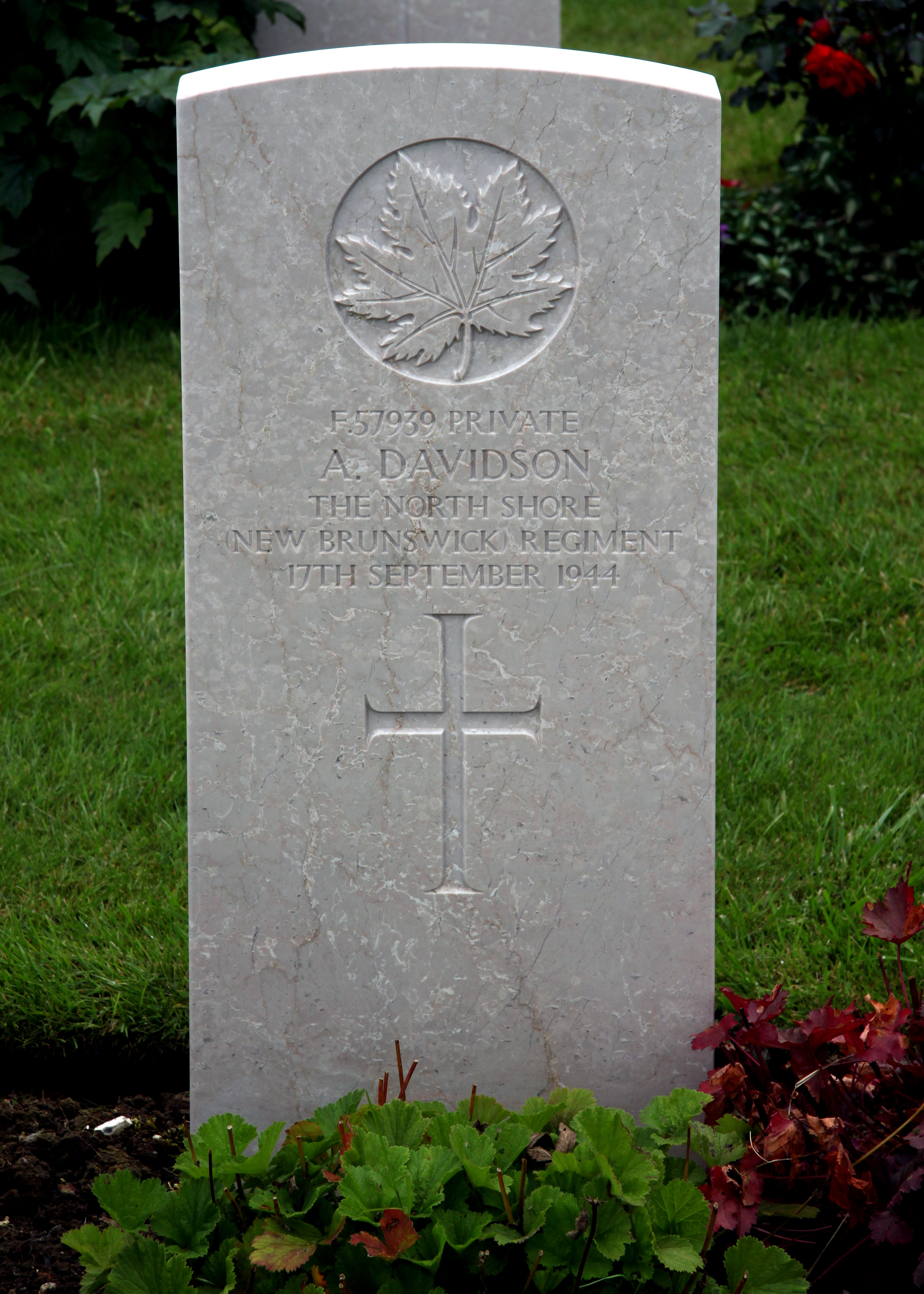
Private Andrew McRitchie Davidson—Died of Wounds September 17, 1944

 Andrew McRitchie Davidson was born in Goldboro, Guyborough County, on October 7, 1913. Andrew’s middle name was a tribute to Dr. J. J. McRitchie, who operated a family medicine practice in the area at the time and was present at Andrew’s birth. Dr. McRitchie later served locally with the Canadian Army Medical Corps during the First World War.

Private Andrew Davidson's headstone, Calais Canadian Military Cemetery, Saint-Inglevert, France (Source: War Graves Photographic Project)

Both of Andrew’s parents were Guysborough County natives. His father, William Marshall Davidson, was the son of John and Margaret (Clark) Davidson, Isaac’s Harbour, while his mother, Sarah Mabel “Sadie” Fanning, was the daughter of Charles and Eunice (Sangster) Fanning, Seal Harbour. William and Sadie married in Country Harbour on July 18, 1902.

At the time of the 1911 decennial census, they were residing in Seal Harbour, where William worked in the local fishery. Four children were also part of the Davidson household at that time—Edith A. (DOB September 1903), Bertha Maud (DOB October 1905), Sidney Shaw (DOB August 1907) and Henry Marshall “Harry” (DOB August 1909).

According to Province of Nova Scotia birth records, a fifth child, Lena Blanche, was born on October 15, 1910, but her name is not listed in census records. Andrew, William and Sadie’s fifth surviving child, was born in October 1913 and later joined by siblings Clara Mable, born in Goldboro on September 10, 1915; William Oland, born in Goldboro on May 22, 1917; and Ernest, born around 1920.

Sometime between 1917 and 1921, the Davidson family relocated to Priestville, on the outskirts of New Glasgow, Pictou County. All eight children were still living at home at the time of the 1921 census. Two years later, tragedy struck the family when Sadie died in the Aberdeen Hospital, New Glasgow, on September 22, 1923. She had been ill with bronchitis for two weeks and was under doctor’s care for one week prior to her death, which was attributed to pneumonia.

Sadie’s passing created a crisis that led to the Davidson household’s dissolution. Based on available records, the four oldest children appear to have remained in Pictou County. Edith married Ernest Myers, a native of Prince Edward Island, in a ceremony held in New Glasgow on February 21, 1926. Her sister Bertha married William McGygan, another Prince Edward Island native, in St. George’s Rectory, New Glasgow, on April 18, 1927.

Sydney Davidson was living on Brother St., New Glasgow, when he married Eva Harding, a native of Burin Bay, Newfoundland, on October 25, 1928. Harry Davidson was working for the Town of Stellarton when he married Euphemia Ann MacLean, a native of Port Hood, Inverness County, at Lourdes, Pictou County, on February 21, 1933. Sadly, Harry died of tuberculosis in St. Martha’s Hospital, Antigonish, on March 31, 1937.

Based on Andrew’s experience, it appears that the four youngest Davidson children were taken into care by the Province of Nova Scotia, placed in a Halifax children’s home, and later “taken in” by foster or adopted families during adolescence. According to his military service file, Andrew, the oldest of the four, “was placed in a [children’s] home and later adopted by a farmer.” His younger sister Clara eventually resided in Barnaby River, New Brunswick, where she married Francis Alvin Murphy, the son of a local family, on July 16, 1936. There is no trace of the Oland or Ernest Davidson in available census, marriage or death records.

William Davidson remained in Pictou County after his wife’s death and his family dissolution. The 1931 Canadian census lists William, age 53, widower, occupation “labourer” at “odd jobs,” living as a “boarder” in the home of Gabriel E. Murray, age 59, 18 MacDonald St., New Glasgow. Gabriel’s wife Janice, age 62, and the couple’s three children also resided there.

According to details in his service file, Andrew completed Grade VIII while residing in a Halifax children’s home and “left school because he had to go to work.”  Around age 14, he was taken in as a ”helper” by Luther Betts, age 54, a railway section foreman, and his wife Catherine, age 56, Malagash, Cumberland County. He was still living there at the time of 1931 census, labouring at “odd jobs.” His service file later credited Andrew with 12 years of work as a “farm labourer.”

On October 20, 1935, Andrew married Annie Laurie Archibald in a ceremony that took place in All Saints Hospital, Springhill. While the couple’s marriage license stated that Annie was the daughter of George H. and Ida May (Hyatt) Archibald, Springhill. Annie later gave birth to two children—Kenneth George Davidson (c. 1935) and Anita Joyce Davidson (c. 1936).

A later letter in Andrew’s service file, written to military authorities by Wallace Carty—a friend of Andrew’s—after his death, states that Annie “was also from the [Halifax children’s] home.” It appears that the Archibalds had taken her into their home. Wallace also stated that Andrew “never lived [separately] with his wife…. He lived with me for some years before joining the services. His parents are dead, also the Mr. and Mrs. Betts who brought him up.”

Around 1941, Andrew went to work in the Malagash Salt Mines. Among his fellow miners was Wallace Carey, a Halifax native. Apparently unemployed in mid-winter 1943/44, Andrew made the decision to enlist with the Canadian Active Service Force at Halifax on January 14, 1944. At the time, he provided Wallace’s name as his next of kin and gave his marital status as “single.”

In late January, Andrew reported to No. 60 Basic Training Center, Yarmouth, where a note in his service file commented on his performance: “Very good progress…. Capable and efficient.” Andrew moved on to A14 Advanced Infantry Training Center, Aldershot, on March 25. While there, he completed a “six-pounder” course. On June 3, he received the standard two-week pre-embarkation furlough.

Andrew returned to duty on in mid-June and proceeded overseas on June 25. He disembarked in the United Kingdom on July 3 and was assigned to 2nd Canadian Base Reinforcement Group shortly afterward. With Canadian infantry units now fighting in both Italy and France, demand for reinforcements was high. On July 17, Andrew departed for the continent and set foot in Normandy the following day. Within 24 hours, he was posted to the North Shore (New Brunswick) Regiment.

The North Shore Regiment (NSR) traces its origins to the 73rd Northumberland New Brunswick Battalion of Infantry, a Canadian militia unit established on February 25, 1870. The  Bathurst-based unit went through several title changes before it was officially designated the North Shore (New Brunswick) Regiment on April 1, 1922.

While the unit recruited an infantry battalion—the 132nd (North Shore)—for service during the First World War, it never served in combat. Upon arriving overseas in November 1916, the 132nd provided reinforcements until early 1917, when it was dissolved and its remaining personnel transferred to the 13th Reserve Battalion.

The NSR was placed on active service on September 1, 1939, and departed for the UK in mid-July 1941 as part of the 3rd Canadian Division’s 8th Canadian Infantry Brigade (8th CIB). Its personnel spent almost three years training and performing home defence duties. During the autumn of 1943 and spring of 1944, the unit and its 8th CIB mates—The Queen’s Own Rifles of Canada (Toronto, ON) and Le Régiment de la Chaudière (Chaudière-Appalaches, QC)—prepared for an Allied invasion of Nazi-occupied France.

The Queen’s Own Rifles (QOR) boarded landing craft at 0630 hours June 6, 1944, and came ashore at Bernières-sur-Mer, Normandy, France, in the first wave of Allied D-Day landings. The North Shore Regiment was part of the second wave, boarding landing craft at 0810 hours and heading for nearby Saint-Aubin-sur-Mer.

The following day, the unit pushed inland toward Tailleville. By June 11, its personnel had advanced as far as Cairon, northwest of the city of Caen. Six days later, the regiment relieved the Royal Winnipeg Rifles at Le Mesnil-Patry. The village was within 10 kilometers of Carpiquet airfield, which was located on the western outskirts of Caen.

The NSR’s first major combat assignment took place in early July, when 8th CIB attacked Carpiquet and the adjacent airfield in fighting that lasted several days The advance commenced in the early hours of July 4 as the New Brunswickers and their Chaudière counterparts cleared the village. The units held their positions for nine days before retiring to a rest area near the city of Caen.

On July 18, the 8th Brigade participated in an Allied push across the Orne River, which ran through the city of Caen. The following day, a reinforcement group of two officers and 87 “other ranks” (OR) arrived in the NSR’s camp. Private Andrew McRitchie Davidson was part of the group, which also included Private Robert Leonard Lawrence, Guysborough.

The NSR relocated to Vaucelles, across the Orne River from Caen, during the late afternoon of July 20. The following day, the unit “stood by” awaiting orders. At 1730 hours, personnel moved forward to Grentheville, south of the Caen - Falaise Road. Heavy artillery fire slowed their progress, the soldiers finally reaching their destination around 2000 hours July 21.

Throughout the NSR’s four days in Grentheville, German artillery heavily shelled the area, particularly during the evening and night hours. In the late afternoon of July 23, Andrew was admitted to No. 14 Canadian Field Ambulance, having received “shrapnel and powder burn (minor)” wounds to his back from an exploding “H E [high explosive] shell.”

Andrew was admitted to No. 11 Canadian General Hospital, Bayeux, Normandy, on July 25 and evacuated to No. 19 Canadian General Hospital in the UK the following day. Fortunately, his injuries were slight and he was discharged to duty on August 8. He immediately reported to No. 4 Canadian Infantry Reinforcement Unit (CIRU), where he awaited orders to return to France.

On August 25, Andrew crossed the English Channel for the third time since his overseas arrival. Upon landing in Normandy the following day, he was assigned to No. 2 Canadian Base Reinforcement Group, where he waited another two weeks before he rejoining the NSR’s ranks on September 8.

By the time of Andrew’s return, Allied units had cleared German forces from the Normandy peninsula and were pursuing the retreating enemy northward toward the Seine River. The NSR was encamped at Reclinghen, approximately 20 kilometers east of Boulogne-sur-Mer, where Canadian units were preparing to clear German forces from several key “Channel Ports” along the French coast.

In anticipation of an Allied attack across the English Channel, German forces had constructed the “Atlantic Wall,” an elaborate network of fortifications that defended strategic locations from attack by sea and land. The area assigned to the NSR’s 8th CIB—the villages of La Trésorerie and Wimille, and the town of Wimereux—were part of this system and contained several gun installations protected by reinforced concrete bunkers.

The 8th CIB attack commenced on the morning of September 17, the NSR advancing across open country toward a fortification in La Trésorerie. The first two attacking platoons quickly reached the village’s outskirts, completed their intermediate objective, and were instructed to wait for supporting comrades to join them.

The initial attack succeeded partly because German forces had not anticipated an attack from that direction. Once the advance resumed, the supporting platoons encountered heavy fire as they attempted to cross the open ground. The initial soldiers had also somehow managed to cross a hazardous minefield without realizing their good fortune. The second wave of attackers was not so fortunate.

Despite attempting a variety of tactics, the forward party was unable to advance further throughout the day. The minefield to its rear eliminated any possibility of retreat, forcing the soldiers to hold their positions as Canadian engineers cleared a path through the mines. Meanwhile, enemy artillery and machine gun fire blanketed the area where the NSR was situated..

At dusk, a group of soldiers pushed forward to the northernmost gun casemate—a fortified concrete chamber from which a gun can fire through a narrow opening—and managed to secure half of the structure. The remaining section—a power plant—was still in German hands. The attackers consolidated their positions through the night and prepared to resume the advance in the morning.

The various fortifications were built with thick concrete walls that had easily withstood the preliminary artillery bombardment. As a result, close combat was required to clear each one, attackers using grenades to enter and flamethrowers to clear each structure. While the NSR managed to secure the southeastern side of La Trésorerie, enemy fire blocked further advance along the village’s eastern edge.

During the morning of September 18, the NSR forward party secured the remainder of the casemate and over-ran a smaller gun position, softening enemy resistance. With the co-operation of a German prisoner of war, the soldiers persuaded the remaining enemy forces in the village to surrender.

As the day progressed, the NSR secured the remaining sections of La Trésorerie. Its war diary commented, “ Casualties had been fairly heavy, but so were those of the enemy.” While the unit captured 450 prisoners during two days of fighting, 16 of its soldiers were killed in action during that time.

Private Andrew McRitchie Davidson was wounded during the September 17, 1944 attack and succumbed to his injuries before day’s end. Eight more NSR soldiers died the same day. Their remains were initially interred in a temporary Canadian military cemetery established at Hardingen, approximately 20 kilometers east of Wimille. On August 1, 1945, Andrew and his comrades were re-interrred in Calais Canadian Military Cemetery, Saint-Inglevert, France.

Calais Canadian Military Cemetery, Saint-Inglevert, France (Source: War Graves Photographic Project)

In the aftermath of Andrew’s death, military officials commenced what quickly became the challenging process of contacting his nearest living next of kin. The search started with Andrew’s friend, Wallace Carty, identified on his attestation papers as a “friend.” In a letter to authorities, Wallace recommended that they contact “Children’s Aid at Amherst, NS,” as Andrew had spent his adolescent years in Malagash with Luther and Margaret Betts, both of whom had passed away.


Months passed before military officials made any progress. A letter from A. J. Mason, Mayor of Springhill, dated October 13, 1945, informed them that Andrew had been married to Annie Archibald, daughter of Mrs. George Archibald, Fir St., Springhill, and that the Davidsons had two children. Annie had been “working in Halifax at different restaurants during the past few years.”

In early November 1945, two Army Provost officers visited a Halifax address where Annie had resided. The landlord at the premises informed them that she had departed two months earlier, leaving her furniture and belongings but no forwarding address. He also informed the officers that Annie had used several names while living there—Mrs. Annie Davidson, Annie Archibald, and Mrs. Stanley Plummer.

In fact, on January 6, 1942, Annie had married Stanley John Plummer, a native of London, England, a marine engineer employed with Canadian National Steamships. The ceremony took place in St. George’s Church, Halifax. Annie was working as a “waitress” in the “HMC Dockyard” at the time. On theProvince of Nova Scotia marriage license, her surname is recorded as “Davison” and her marital status as “spinster.”

A second name written in the “Other Relations” section of Andrew’s paybook provided another lead. The entry identified “Ruby Mattatall, Malagash, NS” as another “friend.” Ruby was in fact the daughter of Luther and Margaret Betts, the family with whom Andrew lived after leaving the Halifax children’s home.

On November 10, 1945, Ruby wrote to the Department of National Defence (DND), confirming Annie’s second marriage and suggesting that DND contact Mrs. George Archibald, Springhill, who was taking care of Andrew and Annie’s children. Three days later, Annie contacted DND herself, confirming arrangements to meet with officials concerning Andrew’s estate.

On December 17, 1945, Annie completed the standard Department of Defence Estates Branch form at Liverpool, where she was employed as “manager” of the South Shore Inn, She identified herself as Andrew’s “widow” and provided officials with significant information—the date and place of her marriage to Andrew, and the names, ages and address of their two children. Annie was unable to provide any details on Andrew’s family, specifically the names of his parents and siblings.

In late December, Ida May Archibald wrote a letter to DND, inquiring about “the money coming to the children of Pte F57838 Andrew Davidson, who was killed overseas in September 1944.” She provided additional information on the family situation:

“As I have kept the children all their lives… I think they have the right to their father’s money. Their mother left them when they were babies and is married for the last three years to Stan Plummer. I am the children’s grandmother and their father asked me to keep them because he had no place to take them and was not working…. [T]hey are getting big and need their money to help them in school…. Their mother has never given them anything in 10 years.”

In April 1946, the Department of National Defence dispersed one-third of Andrew’s estate funds to Annie Laurie Plummer and sent the remaining two-thirds to his two minor children, c/o Ida May Archibald. In March 1950, military officials dispatched a Memorial Bar to Andrew’s son, George Kenneth Davidson, Fir St., Springhill.

According to information included an Ancestry.ca family tree, Andrew’s father William Marshall Davidson passed away in Prince Edward Island in 1945. The exact date and location cannot be confirmed. At present, no further information is available on the subsequent lives of Andrew’s widow Annie or his two children.