Photo Caption & Contact Email

Banner Photograph: Members of the North Nova Scotia Highlanders in England, 1941 (courtesy of Robert MacLellan, Cape Breton Military History Collections)

Contact E-mail Address: brucefrancismacdonald@gmail.com

Saturday, 8 June 2024

Private James Wallace Corkum—Died of Wounds June 8, 1944

 James Wallace Corkum was born in Port Bickerton, Guysborough County, on September 9, 1919, the older of Judson Randolph and Alma (Turple) Corkum’s two sons. James was a direct descendant of Johan Wilhelm Von Gorkum (1713 - 1783) and his wife, Sophia Catherina Speiss (1718 - 1793), Westhofen, Rhine Palatine, Germany. The couple and their five oldest children arrived in Halifax, NS, around 1751 as part of a British initiative to establish a Protestant population in the British colony.

Private James Wallace Corkum's headstone, Cassino Military Cemetery

The following year, the family joined a large group of recently arrived German Protestant and French Huguenot families in establishing a new settlement at Lunenburg. Three more children joined the Von Gorkum household after their arrival in Nova Scotia. Over time, the family surname was changed to “Corkum.”

George Heinrich “Henry” Corkum (1749 - 1836), Johan and Sophia’s fourth child, married Elizabeth Collicutt (1775 - 1836) on September 6, 1777. The couple raised a large family of 14 children—eight daughters and six sons—in the Lunenburg area. One of Henry and Elizabeth’s sons, John William, was born in Chester on October 17, 1782, and married Salome Dohnig (1784 - 1870) at Lunenburg on May 18, 1809.

Like his father, John William presided over a large family that grew to include five sons and five daughters. Uriah (1824 - 1891), John William and Salome’s second-youngest child, was born in Lunenburg in 1824 and eventually settled in Peggy’s Cove. Around 1852, Uriah married Mary Charlotte Kaiser (1828 - 1881). The couple raised a family of four children—daughters Emmeline (1853 - 1938) and Dora (1881 - ), and sons Norman Stanford (1864 - 1930) and Ira Judson (1866 - 1938).

Uriah and Mary Charlotte’s oldest son, Norman Stanford Corkum, relocated to Guysborough County, where he married Olive Blanche Keizer (Kaiser), daughter of Amos and Sarah Keizer, Port Bickerton, on December 12, 1889. Norman and Blanche raised a family of six sons and four daughters—Evelyn (1890), William (1893), Judson Randolph (1895), Sarah (1896), Esther Olga (1898), Jenny (1900), Cecil (1903), Harry (1904), Vernon (1905) and Everett (1907 - 1999).

Judson Randolph, Norman and Blanche’s third child, married Alma Regina Turple, daughter of Angus and Esther Turple, Clam Bay, Halifax County, at Pictou, NS, on November 1, 1918. While Judson and Alma were both living in Pictou County at the time of their marriage, they set up home in Port Bickerton, where their first child, James Wallace, was born on September 9, 1919. A second son, Carl Douglas, joined the family on March 4, 1921.

Alma passed away on February 3, 1924, at age 26 and was buried in Caribou, Pictou County, where her parents resided. On November 19, 1924, Judson married Olive Viola Rudolph, daughter of John and Eliza (Hallett) Rudolph, Liscomb, in a ceremony held in St. James Rectory, Pictou. Judson and Olive subsequently raised two children—a daughter Daisy Regina (c. 1926) and a son Robie Monahan (c. 1932)—in their Port Bickerton home. A fifth child, Francis (1920 - 1990), a son of Olive’s by a previous relationship, was also raised in the Corkum household.

James Wallace Corkum left school after Grade 4 and went to work in the local fishery around 1930. His younger brother Carl Douglas died of pulmonary tuberculosis at home on August 20, 1938, after a brief illness. He was only 17 years old at the time of his passing.

The outbreak of war overseas soon impacted James Corkum’s life. Under the terms of the National Resources Mobilization Act (NRMA) passed by the Canadian Parliament in June 1940, Canadian men of military service age were required to register with the federal government. On March 22, 1941, James completed a medical examination at Sherbrooke to determine his fitness for service. One month later, in compliance with NRMA requirements, James enlisted with the Canadian Army Reserve at New Glasgow.

On June 7, 1941, James was officially “taken on strength” at No. 6 District Depot, Halifax, and attached to No. 61 Basic Training Centre, New Glasgow, for training. In late June, he proceeded to Camp Aldershot for advanced infantry instruction. After several months at Aldershot and Yarmouth, he departed for overseas on November 10, 1941.

Two weeks later, James arrived in the United Kingdom and reported to No. 2 Canadian Infantry Reinforcement Unit (CIRU), where he awaited further orders. Transferred to No. 1 CIRU on December 5, 1941, he spent three months with the reinforcement unit before being assigned to the West Nova Scotia Regiment on March 11, 1942.

The West Nova Scotia Regiment was created in 1936 when the Lunenburg and Annapolis Regiments were amalgamated into one unit. The battalion officially mobilized for service on September 1, 1939, and departed for overseas in December 1939. Military officials assigned the “West Novas” to the 1st Canadian Division’s 3rd Brigade, where its soldiers served alongside the Carleton & York Regiment (New Brunswick) and the Royal 22e Régiment (Quebec’s “VanDoos”).


James spent the next 16 months training with the West Novas and serving in various “home defence” assignments. During that time, 2nd Canadian Division units participated in the ill-fated Dieppe raid (August 1942). In its aftermath, Allied leaders continued to discuss the possibility of an invasion of German-occupied Europe, While they concluded that the situation was not yet right for a campaign in Western Europe, a consensus gradually formed around an invasion of Italy, German’s Axis ally.

British Prime Minister Sir Winston Churchill described the Mediterranean theatre and Italy in particular as the “soft underbelly of Europe.” Italian forces were considered inferior to their German counterparts and the chances of military success were thus considered much better. The details of the plan took shape throughout the early months of 1943 as British, Commonwealth and American units rehearsed amphibious landings in various locations around the United Kingdom.

The 2nd Canadian Division had suffered considerable losses at Dieppe and was rebuilding its ranks. The 3rd Canadian Division was the last to arrive overseas and military commanders believed that its units required more training. As a result, the entire 1st Canadian Division was assigned to the Allied Mediterranean Force that assembled in late June 1943 and departed for Italy in early July.

The invading force came ashore in Sicily on July 10, 1943, and fought its way across the island over the next five weeks. Canadian forces crossed the Strait of Messina to Reggio, located on the southernmost tip of the Italian peninsula, on September 3, 1943. A larger American and British force landed at Salerno, south of Naples, several days later.

Throughout the autumn of 1943, Allied units pushed their way northward. While the Italian government officially surrendered shortly after the mainland invasion, German units firmly resisted the advance. Canadian units spent the early months of 1944 in Allied sectors north of the town of Ortona, which had been liberated in late December 1943.

While British and Canadian forces advanced slowly up the Adriatic coast, an Allied army consisting of American, British and Commonwealth forces on the western coast, adjacent to the Tyrrhenian Sea, struggled to advance toward the capital of Rome. While American and British units had landed at Anzio and Nettuno on the German right flank, the units were unable to advance beyond their beach-head along the Pontine Marshes.

In an effort to break the deadlock on the western coast, Allied commanders devised plans to launch an attack inland, east of the Anzio beach-head. The primary target was the Liri Valley, located between the Lepini Mountains on its western side and the main chain of Apennine Mountains to the east. The entrance to the valley stretched for 15 to 20 kilometers from the town of Cassino beneath the Apennines to the Liri River, which wound its way northwestward along the valley’s western side.

The Liri Valley provided a direct route to the Alban Hills, beyond which lay the Italian capital. Recognizing its strategic value, German forces established an elaborate defensive system to block Allied access to the area.  Monte Cassino, a former monastery located in the Apennines above the town of the same name, provided an excellent vantage point for observing Allied troop movements.

Behind the valley entrance, the Germans constructed two elaborate defensive lines. The first, called the Gustav Line, lay in the area around Pignatoro, while a larger system, dubbed the Hitler Line, was located further north, in the region of Pontecorvo. On the eastern side, the Polish Corps was assigned the unenviable task of dislodging German forces from atop Monte Cassino. Meanwhile, British and Commonwealth forces focused on the central and western sectors of the valley entrance.

The Allied attack on the Liri Valley commenced on May 11, 1944. French, British and Indian units advanced as far as the Gustav Line on the first day. While Polish forces on the eastern flank continued their efforts to dislodge enemy forces atop Monte Cassino, Allied commanders sought to exploit the gains made in the central and western sectors of the line.

On May 15, Canadian units moved forward to support areas behind the Allied line’s western sector. The West Nova Regiment departed from their camp at Bucciano and travelling by motor transport through mountainous terrain to the Liri Valley in hot, dry weather.

The following day, the soldiers had their first glimpse of their next objective—a lush, green valley nestled between mountains on either side, the landscape dotted with orchards and fields of tall grass or waist-high wheat. Streams running from the mountains wound their way across the valley, carving deep gullies that created obstacles for tanks and armoured vehicles. Shrubs and trees along their banks provided excellent cover for anti-tank weapons.

The West Novas relieved a Mahratta battalion from the Indian Division on the evening of May 16. The following morning, the soldiers were served a hot breakfast and then formed up along the Pignatoro - Pontecorvo Road, where they awaited orders to advance. Enemy artillery and mortar fire blanketed the area, inflicting several casualties.

Around mid-morning, the West Novas passed through their Royal 22e Régiment comrades’ line and attacked the remnants of the Gustav Line. The defences consisted of slit trenches, machine gun, mortar and neberwerfer (rocket-propelled projectiles) pits and fortified houses scattered across the fields and orchards. Two Companies led the way, with support from British tanks, while the remaining two Companies followed in support.

Numerous German soldiers surrendered as the unit pushed forward, while an occasional group, usually occupying a farmhouse, resisted but were quickly overpowered. Snipers in trees and along the roads posed a greater threat, but overall enemy resistance collapsed quickly. Most casualties were the result of artillery and mortar fire.

Tanks supporting the advance encountered a ravine several hundred meters from the start line and fell behind the advancing infantry. The armoured vehicles soon caught up and provided supporting fire as the unit consolidated its positions. By nightfall, personnel were safely entrenched in fields near a farmhouse called Case di Georgio, located on a bend of the highway from Pignatoro, which extended into the valley.

Under cover of darkness, West Nova soldiers pushed forward approximately three kilometers and established a base from which their Carleton & York comrades could continue the advance the following day. Artillery shelling continued to strike the area throughout the evening, but casualties were light. Meanwhile, German forces gradually withdrew to the Hitler Line, blanketing the main roads with harassing mortar and artillery fire.

Over the next several days, the 3rd Brigade’s three units rotated through advanced positions in a series of “leap frog” movements. On May 19, the West Novas swung westward and passed through the Royal 22e’s lines under intense artillery, mortar and machine gun fire. The maneuver involved crossing the 20-foot-wide Forme d’Aquino, a stream running through a deep gully.

Once on the other side, the soldiers made their way across a swampy flat covered with bushes and dug in along a low ridge in the evening hours. A heavy rain commenced during the night and continued into the morning of May 20, creating uncomfortable conditions. The sun emerged in the afternoon and support personnel brought hot meals to the men. The unit held its position for the next 48 hours.

By May 22, Canadian forces had reached the Hitler Line and adjusted their brigades in preparation for an attack on the Liri Valley’s final defences. Following a preliminary bombardment, three Canadian battalions, including the 3rd Brigade’s Carleton & Yorks, would launch the initial advance with tank support.

Their target consisted of a series of well-concealed slit trenches, machine gun, mortar and nebelwerfer emplacements hidden in wooded areas. In every stone structure, German forces established strongpoints, reinforced by sandbags and equipped with dugouts under their earthen floors. Tanks were concealed in clusters of shrubs or buried almost to turret depth in grain fields that provided cover for the weapons. Artillery covered all approaches, while low belts of barbed wire and personnel mines were planted across the landscape.

At 4:30 am May 23, the West Novas ate breakfast and moved into their assigned positions at first light. In front of them, the Carleton & Yorks launched the opening attack as a rolling artillery barrage provided cover. In response, German artillery shelled the Canadian support areas. Many of the tanks supporting the attack fell victim to fire from well-concealed positions and self-propelled guns moving through wooded area by-passed by the infantry during its advance.

So many tanks were lost in the initial attack that infantry units were forced to pause until replacements arrived. Rain began to fall at mid-morning and became a torrential downpour by afternoon. Support personnel brought hot meals forward while the soldiers waited. As the hours passed, German artillery, nebelwerfer and mortar fire impacted the West Novas’ ranks. C Company had set out with 107 men but had its ranks reduced to 55 before day’s end.

Tank support from the Trois Rivières Regiment finally arrived around 4:30 pm and the advance resumed. The West Novas’ A & B Companies passed through the Carleton & Yorks’ line in front of the Pontecorvo - Aquino Road. The 1st Canadian Brigade to the soldiers’ left had moved forward along the Liri River’s west bank but were soon held up. Similarly, on the right flank the 2nd Brigade encountered fierce resistance, gaining little ground while suffering heavy casualties.

The West Novas’ successful advance created an opportunity to have a significant impact on the attack’s final outcome. The Pontecorvo - Aquino road in front of them represented the best escape route for German forces. Close by, a second road out of Pontecorvo ran northward at an angle to their location. If the West Novas could secure it, German forces would be cut off from possible retreat. As Pontecorvo was the Hitler Line’s main bastion, its capture would result in the line’s collapse.

Brigade commanders immediately recognized the opportunity and ordered the West Novas forward with orders to cut off the second road and hold it at all costs. A & B Companies immediately advanced, following a supporting artillery barrage. The attack surprised the Germans opposite their location, prompting many to surrender without opposition. The few posts that held out were left to C & D Companies as they carried out a “mopping up” operation.

While supporting tanks were unable to cross a deep gully, the soldiers pressed forward on their own, passing through a German counter-barrage and reaching the second Pontecorvo road before sunset. Along the way, the unit overcame spotty resistance, advancing to a ridge beyond the road where the men established a defensive position.

The West Novas assumed that the 48th Highlanders had advanced to positions on their left flank. Unbeknownst to them, German forces had gathered along a smaller road in that area, shielded from view by thickets and small hills. Within minutes, the Nova Scotians became the target of a significant counter-attack from the front and left that spread to their rear. D Company officers soon spotted large numbers of German soldiers moving through grain fields on their left flank. While they placed an urgent call for artillery support that dealt with the attacking force, the Company lost an entire section before the threat was eliminated.

Meanwhile, a large group of enemy soldiers assembled in front of A Company and prepared to attack its position. While officers requested an artillery barrage, the soldiers dug in close to the road in preparation. To make matters worse, while the West Novas were engaged in defending their position from attacks on the western flank, a second German force from Pontecorvo crept through waist-high grain along the southeastern side of the road, well past the rear of C & D Companies. As daylight began to wane, the enemy attacked A Company from the flank and rear.

A Company’s forward platoons, busy digging in and having no weapons at hand, were taken completely by surprise. The soldiers who survived were taken prisoner. As German forces escorted their captives northward along the road, they unexpectedly encountered the West Novas’ B Company, which fired its machine guns over the enemy soldiers’ heads before focusing on the German column. In an effort to escape, the Canadian prisoners quickly dove into the surrounding fields.

Also unknown to the other three Companies, a small number of A Company soldiers had survived the German attack and established a defensive position in slit trenches around their headquarters. The group of 10 soldiers managed to hold off enemy forces advancing toward them through the grainfield. To their left, D Company, spread out among farmhouses about 700 to 800 meters to the left of the road, were in considerable danger as they were totally unaware of what was happening to their comrades.

As night fell, German soldiers and one tank attacked D Company from the front, while another group attacked from the left flank, supported by two tanks. The West Nova soldiers managed to force the attacking forces to the ground, but suffered considerable casualties in the process. Discouraged by anti-tank fire in the dwindling light, the German tanks eventually withdrew, providing some relief to the besieged Nova Scotians.

C Company also found itself in a precarious situation, cut off with D Company in the direction of Pontecorvo and well behind German lines. Meanwhile, B Company was isolated on the ridge to the northeast. Between the two groups lay a handful of A Company survivors, clutching to a strip of land along the Pontecorvo road.

Lieutenant-Colonel Ronald Stephen Edward Waterman, the West Novas’ commanding officer, managed to inform Brigade commanders of the situation and a troop of the Trois Rivières Regiment’s tanks, was immediately dispatched to rescue the beleaguered group, accompanied by whatever West Nova soldiers were available at battalion Headquarters.

With support from three tanks, an officer and 18 reinforcements managed to reached A Company. The small group’s arrival persuaded attacking German forces that their numbers were much larger by continually moving their four Bren guns to various locations throughout the evening. By 1:00 am May 24, the situation had stabilized but still remained perilous.

During the night, the West Novas could hear the sound of transports moving along the nearby road. While the soldiers assumed the vehicles were elements of the 1st Canadian Brigade, they were in fact German soldiers fleeing Pontecorvo. Their Canadian comrades did not enter the town until after daylight on the morning of May 24. German forces around the West Novas’ positions followed their retreating comrades, gradually making their way northwest along a cart track that passed through the fields.

As dawn broke, tanks from the 5th Canadian Armoured Division greeted the weary West Novas. The armoured vehicles had managed to advance through a gap in the Hitler Line and were pursuing the retreating enemy. Their arrival assisted the beleaguered unit in driving off the final German attacks on its positions.

During the morning, the remaining West Nova soldiers withdrew to positions behind the Pontecorvo road, while the Irish Regiment of Canada and the 5th Armoured Division’s tanks pursued the retreating German forces, Thomas Raddall, author of the West Novas’ comprehensive unit history, described what transpired in the aftermath of the regiment’s rescue:

“Most of the [West Novas'] dead were buried where they fell, but Padré Wilmot managed to collect the bodies of 14 where the Regiment had passed over the Pontecorvo - Aquino Road, close to a dug-in German tank which had done great damage before it was destroyed. Here they were buried in a small plot on the east side of the road immediately opposite a small Italian wayside shrine.”

The last of the wounded West Novas were evacuated from the battlefield at 4:00 pm May 24. Meanwhile the 5th Canadian Armoured Division reached the Melfa River, a tributary of the Liri located eight kilometers in front of the Hitler Line. The West Novas remained in the line until May 26, at which time its war diary described the state of its soldiers:

“…[B]attalion practically out on its feet[,] having been fighting in or under shell and mortar fire continually since 16 May with very little sleep…. Our best moment in days - [orders received] to move forward about one mile to [a] new area, dig in and sleep.”

The final attack on the Hitler Line was a costly one for Canadian units. A total of 272 soldiers were killed and 601 wounded on May 23, 1944. The West Nova Scotia Regiment was particularly hard-hit during its Hitler Line tour. From May 16 to 26, Commonwealth War Graves records indicate that the unit suffered a total of 48 fatalities. May 23 in particular accounted for almost one-third of these losses—17 West Nova soldiers were killed that day.

Private James Corkum was among the wounded soldiers evacuated to field ambulance for treatment.  According to documents in his service file, he had received a compound fracture of his left femur and right hand, and a “penetrating” wound to the right lower quadrant of his abdomen. The nature of his injuries suggests that he had been struck by shrapnel from an exploding artillery or mortar shell.

By June 4, James had been transferred to No. 5 Casualty Clearing Station, where his condition was described as “dangerously wounded.” He lingered for several days before succumbing to his wounds on June 8, 1944. James was initially buried in a small cemetery near Pignataro Interamna, Frosinone, Italy.

A letter from military authorities to James’ father Judson, dated June 19, 1944, informed him that his eldest son had “died as the result of wounds received in action against the enemy.” James’ remains were re-interred in Cassino Military Cemetery, Cassino, Italy, on March 12, 1945.

Cassino Military Cemetery, Cassino, Italy

Olive Corkum passed away at home on December 15, 1959, and was laid to rest in Hillside Cemetery, Port Bickerton. Her husband Judson Randolph died on December 14, 1962, and was buried in Wine Harbour.

Images courtesy of The War Graves Photographic Project.

Friday, 7 June 2024

Corporal Floyd Edwin MacKenzie—Killed in Action June 7, 1944

 Floyd Edwin MacKenzie was born in Roachvale, Guysborough County, on May 18, 1921, the youngest of Alexander Edward and Mildred Sophia (Horton) MacKenzie’s four children. Alexander was the son of Edward and Eliza (George) MacKenzie, while Mildred was the daughter of Moses Cook and Caroline Orissa “Carrie” (Nickerson) Horton, Roachvale. Mildred’s brother, Vernon Cecil Horton, served overseas with the Royal Canadian Regiment during the First World War. Several years after returning home, he died in Roachvale on March 31, 1926, from sickness related to his military service.

Corporal Floyd Edwin MacKenzie

Alexander and Mildred’s first child, Edmund Clyde, was born in 1910 but died on September 27, 1915, at five years of age. A daughter, Mildred Elizabeth, joined the family on January 8, 1915, while a second son, Alexander Cecil, arrived on January 10, 1917. Floyd, the youngest of the Mackenzie children, was born in 1921.

Floyd’s father Alexander suffered from asthma and allergy-related respiratory problems throughout his life. The dusty conditions of farming and Nova Scotia’s damp weather significantly impacted his health, prompting doctors to suggest a change in climate. Years earlier, Alexander’s sister Beth had left for the United States, where she worked as a buyer for J. L. Hudson Department Stores. Beth invited Alexander and his young family to reside with her, in hopes that the move would improve Alexander’s health.

During their time in the United States. Beth’s job took the MacKenzie family to Detroit, Michigan; Los Angeles, California; and Long Island, New York. Despite the change in environment, Alexander’s health did not improve. Eventually, the family returned to Roachvale, where Alexander resumed operation of the family farm.

Several years after returning to Nova Scotia, a farming accident triggered a series of health issues that led to Alexander’s death. A horse accidentally crushed his foot, the shock of the injury triggering a severe asthma attack. His respiration gradually worsened and he died on April 6, 1938. Alexander’s death certificate attributes the cause of death to lobar pneumonia, with asthma and pulmonary emphysema as contributing factors. He was 69 years old at the time of his passing.

Floyd left school at age 14, having completed Grave VII, and went to work on the family farm. After his father’s passing a few years later, he and his older brother Alexander Cecil assumed operation of the family farm. Floyd worked  there for five years prior to his military enlistment.

On July 1, 1940, Floyd attested for service with the Pictou Highlanders at Mulgrave, NS. At the time, the militia unit was stationed the Strait of Canso, where its personnel performed guard duty at two coastal artillery batteries established in Auld’s Cove and Sand Point shortly after the outbreak of war overseas.

Floyd was 19 years old at the time of his enlistment and was just over six feet tall. Despite a lack of previous military experience, he was immediately transferred to the North Nova Scotia Highlanders for infantry training. Initially established as a machine gun unit in 1936 following the amalgamation of militia units from Cumberland, Colchester and Hants Counties, the unit established its headquarters in Amherst after the outbreak of war overseas. The battalion subsequently transitioned to an infantry unit and assigned to the 3rd Canadian Division’s 9th Brigade, where it served alongside the Highland Light Infantry of Canada (Waterloo, ON) and Stormont, Dundas & Glengarry Highlanders (Cornwall, ON).

Floyd spent the remainder of 1940 in Amherst, where he completed infantry training. He received a two-week furlough in mid-January 1941 and several days’ “pre-embarkation leave” in mid-July, returning to the North Novas in time for their overseas departure on July 18, 1941. The unit spent the next three years in the United Kingdom training and performing British “home defence” duty.

Within months of his overseas arrival, Floyd had made an impression on his superior officers. On April 17, 1942, he was promoted to the rank of Acting Lance Corporal. He advanced to Acting Corporal two and a half months later and was “confirmed in the rank of Corporal” in mid-November. Floyd maintained his non-commissioned rank for the duration of his overseas service. The rank brought with it considerable responsibility—Floyd was one of two non-commissioned officers (NCOs) responsible for the operation of a platoon section.

The 3rd Division’s battalions were the last Canadian infantry units to arrive overseas. The 2nd Division provided infantry units for the ill-fated Dieppe Raid (August 1942), where they suffered significant losses. When Allied commanders assembled plans for an invasion of Italy in early 1943, the 2nd Division was still rebuilding its ranks and the newly arrived 3rd Division had the least amount of training. As a result, the 1st Canadian Division was selected to depart for Sicily in early July 1943 as part of the Allied Mediterranean Force.

Following the invading force’s departure for Italy, 2nd and 3rd Division personnel in the UK participated in a series of training exercises in Scotland and England. The focus was on an eventual Allied invasion of Western Europe tentatively planned for 1944. Several exercises were large-scale manoeuvres where units rehearsed amphibious landings.

On June 3, 1944, the North Nova Scotia Highlanders broke camp and travelled to Southampton, where its soldiers boarded a ship. The unit awaited further orders while anchored off nearby Netley. The flotilla of vessels assembled in the inlet moved out open sea at 1400 hours June 5 and “formed up” in preparation for departure for France.

Around 0800 hours June 6, 1944, the first wave of British, American and Commonwealth units came ashore on the beaches of Normandy. Infantry battalions from the 3rd Canadian Division’s 7th and 8th Brigades landed on Juno Beach, where they established a beach-head. The North Novas began their trek ashore to a beach near Bernières-sur-Mer, slightly east of Juno Beach, at 1140 hours, one hour later than planned. The only casualties occurred when a mortar carrier struck a mine after landing on the beach, wounding several crew members.

As the beach was crowded with landing craft, it took more than two hours for all North Nova soldiers to come ashore. The 8th Brigade, which was part of the first wave landings, ran into stiffer resistance in Bernières-sur-Mer than anticipated. As a result, the North Novas were unable to proceed through the town to their designated assembly point near Bény-sur-Mer, approximately six kilometers inland. In response, the North Nova’s Commanding Officer (CO), Lieutenant-Colonel Donald F. Forbes, decided to gather his men in a nearby field.

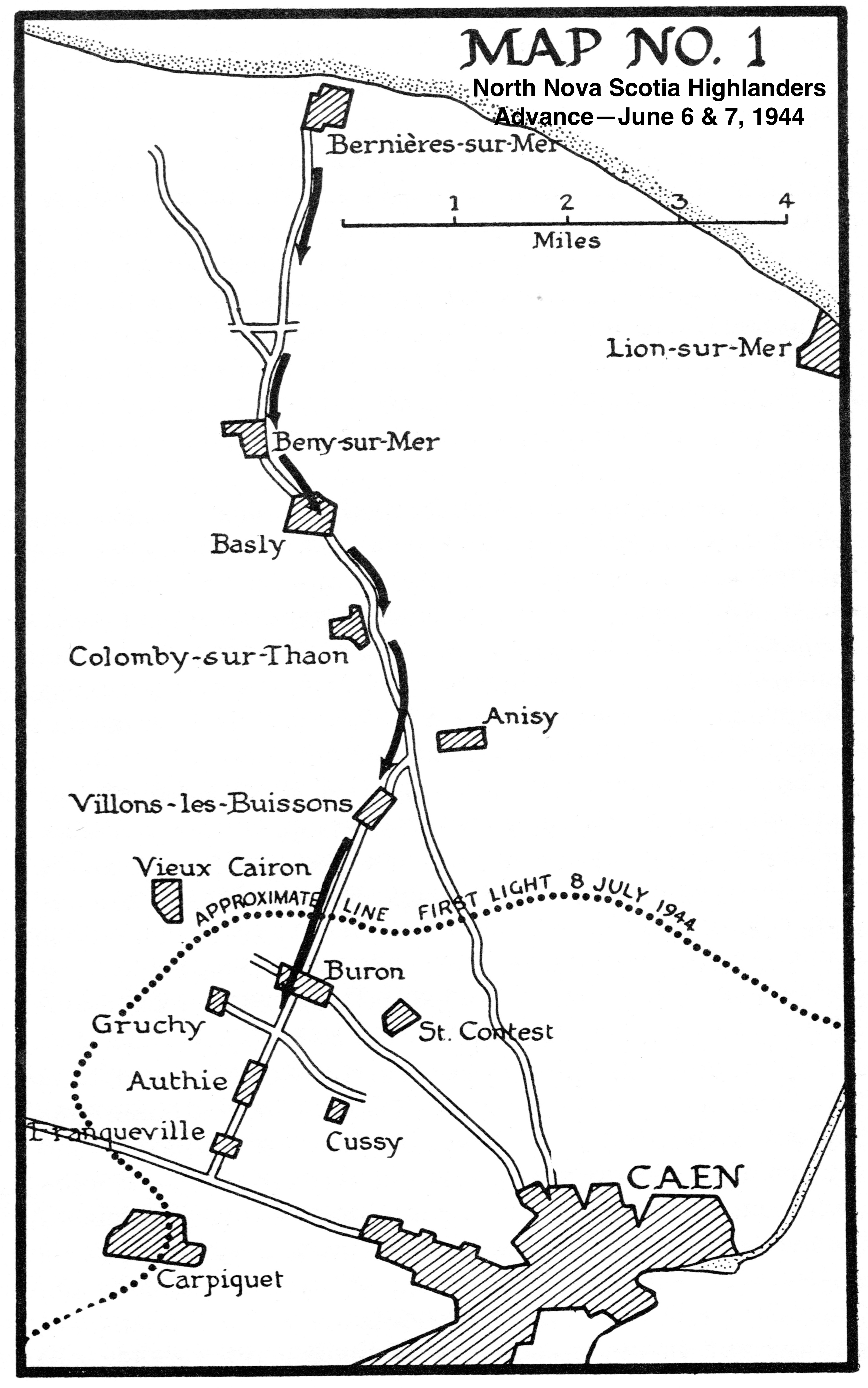
At 1605 hours, the unit was finally ready to “move off,” reaching at a designated assembly area 40 minutes later. Its war diary noted, “We had just arrived in this…[location] when we came under shell and mortar fire, resulting in five casualties, two killed and three wounded.” At 1820 hours, the battalion finally moved off toward its objective—Carpiquet airfield, on the western city of Caen, approximately 20 kilometers inland from the beach where they landed.

Leading the vanguard’s advance was the “recce” troop of the 27th Canadian Armoured Regiment (Sherbrooke Fusiliers), its tanks forming a screen in front of the advance force. Behind the tanks were two personnel carriers transporting two C Company platoons, a Machine Gun platoon, one troop of M-10 mobile anti-tank guns, two pioneer assault sections, and four detachments of the unit’s anti-tank guns.

Behind the vanguard, A Company’s men moved inland aboard the tanks of 27th CAR’s A Squadron on the right side of the advance, while the 27th CAR’s B Squadron transported B Company’s soldiers on the left flank. D Company, riding aboard the 27th CAR’s C Squadron’s tanks, brought up the rear.

Source: Will R. Bird, No Retreating Footsteps: The Story of the North Nova Scotia Highlanders

The vanguard encountered no serious resistance until it reached the outskirts of Villons-les-Buissons, approximately 11 kilometers inland. As evening was approaching, military commanders realized that the unit would not reach its objective before dark. In response, they ordered the vanguard to dig in for the night. The unit’s war diary reported a total of four “other ranks” (OR) killed and another six wounded during the North Nova’s first day in Normandy.


At 0300 hours June 7, 27th CAR’s tanks dispersed an attempted German counter-attack. Shortly afterward, enemy mortar and machine gun fire was heard to the rear of the unit, as German forces attempting to cut around behind the NNSH’s position encountered the 8th Brigade’s Régiment de la Chaudières. Significant losses forced the enemy force to withdraw.

At 0740 hours, the North Novas moved off in the same order, following the main road from Villons-les-Buissons to Carpiquet. The unit’s war diary noted that the area “was full of [German] snipers and machine guns.” To the right of Villons-les-Buissons, an 88-mm gun opened fire on the lead tanks but was quickly silenced. By 0930 hours, the vanguard had cleared enemy forces from the village and moved on to Buron, where a second 88-mm gun was captured.

By 1150 hours, the vanguard had passed through Buron and proceed onward toward Authie. D Company was assigned the task of “mopping up” remaining enemy forces in the Buron area, while A and B Companies pressed forward behind the leading force. When D Company personnel reached the outskirts of Buron, they immediately encountered heavy mortar shelling, in addition to sniper and machine gun fire from pockets of German soldiers hidden in the village.

Meanwhile, the vanguard reached Authie, where it encountered three German machine gun posts. “Hectic fighting” ensued as enemy mortar and artillery fire struck their location from both flanks, as well as from positions beyond the village. Officers commanding the vanguard immediately radioed for tank and artillery support. Unfortunately, Allied artillery guns were out of range and could not respond to the request.

As a troop of 27th CAR support tanks arrived, several German 88-mm guns opened fire on the armoured vehicles. Meanwhile, realizing that further advance was not possible, the vanguard’s soldiers attempted to dig in and establish a firm base. Allied units on both flanks—the 3rd British Division to the left and the 7th Canadian Infantry Brigade on the right—had not kept pace with the North Novas’ rapid advance, placing the soldiers in a perilous situation. In fact, the unit had advanced further inland on June 7 than any other Allied unit, leaving both flanks exposed to German infantry and armoured counter-attack.

In response, vanguard personnel on each flank were ordered to join C Company in forming a “fortress.” A Company dug in on the right, just north of Authie. B Company, however, had not kept pace with the vanguard. It received instructions to dig on on the left flank as soon as it reached the area. Meanwhile, the remainder of the battalion held its position in the rear.

As the North Novas attempted to establish a firm defensive formation, nine German tanks and two German infantry companies attacked from the direction of Saint-Contest and Cussy. Their action effectively eliminated any possibility of retreat. In response, North Nova officers in charge of the vanguard decided to “fight it out in front of Authie.” The unit’s June 7 war diary entry reported, “Nothing further was heard from this small formation and no one escaped to tell the story of their gallant action.”

Shortly after the first German counter-attack, additional enemy tanks launched a second assault from the area beyond Authie. All available 27th CAR tanks quickly moved forward from positions south of Buron and a major armoured battle ensued. A total of 27 Canadian and 40 German tanks were destroyed before enemy forces withdrew.

Unfortunately, B Company only managed to reach a location south of Buron and was unable to assist their besieged comrades at Authie. By 1630 hours, Headquarters deemed it impossible for the rest of the battalion to push forward and issued orders to “bring the forward troops back” and form a fortress south of Buron.

The Buron area itself soon came under heavy German artillery and mortar fire. Enemy tanks broke through on the flanks, making the location untenable. In response, the remnants of B Company withdrew to previously dug slit trenches to the rear of D Company. The battalion “went to ground and prepared to hold on to the last.”

As the German tanks approached Buron on the flank, the remaining 27th CAR tanks and available self-propelled guns opened fire from a wooded area near Villons-les-Boissons. Supporting machine gun and rifle fire from positions north of Buron also targeted the approaching enemy armour. German guns immediately neutralized the fire from Buron, allowing enemy soldiers to penetrate D Company’s forward slit trenches.

Unable to rise and engage and the attacking enemy, two D Company platoons surrendered after expending their ammunition. When a heavy Allied counter-barrage forced the attackers to the ground, two sections of one D Company platoon managed to escape to the rear.

By that time, D Company reported that enemy forces had overrun its forward positions and requested immediate support. A rapid counter-attack force was assembled and fierce fighting followed under a heavy Allied artillery concentration. With support from a dozen remaining 27th CAR tanks, North Nova soldiers pushed forward under cover of an artillery barrage and drove enemy forces back toward Authie.

The North Novas managed to recapture Buron, but lacked sufficient manpower to consolidate and hold the position as darkness set in. What remained of the unit and 27th CAR received permission to withdraw to high ground in a wooded area near Villons-les-Buissons, where the 9th Brigade’s Stormont, Dundas & Glengarry Highlanders were also encamped.
 
Meanwhile, A Company near Authie found itself surrounded by German infantry and tanks and was unable to withdraw to safety. After holding out for several hours against a much larger enemy force, its remaining soldiers surrendered at 1700 hours June 7. Some vanguard personnel managed to slip into the surrounding wheat fields during the late afternoon and evening hours and retreated to Villons-les-Buissons, where they joined their North Nova comrades in the wooded area.

No counter-attack developed during the night as the North Novas and 27th CAR prepared to re-occupy Buron after daybreak. Military commanders subsequently cancelled the orders as the remainder of the 9th Brigade moved forward and occupied the town of Villons-Les-Buissons to the right of the wooded area.

The North Novas’ June 7 war diary entry recorded the day’s losses as known at that time—one officer and 10 “other ranks” (OR) killed; three officers and 27 OR wounded; and a shocking nine officers and 195 OR missing. Over the next several days, additional information allowed officials to account for many of the missing. In the final tally, 16 officers and non-commissioned officers and 37 OR were killed on June 7, 1944, while 20 officers and NCOs and 88 OR were wounded. Corporal Floyd MacKenzie was among the North Nova soldiers killed during the day’s tumultuous combat.

Approximately 84 soldiers were officially listed as “missing.” While the majority were later accounted for as prisoners of war, 12 of the missing North Novas were part of a group of 18 men executed by German SS at Abbaye d’Ardennes on June 7 and 8, 1944. Their remains were not discovered until after Allied forces secured the area weeks later and local civilians returned to their homes.

On June 16, 1944, Mildred MacKenzie received a telegram from Canadian military authorities, informing her that her son “Corporal Floyd Edwin MacKenzie has been officially reported killed in action 7th June 1944.” Floyd was initially buried in a temporary cemetery at Beny-sur-Mer. On April 27, 1945, his remains were re-interred in Beny-sur-Mer Canadian Cemetery, Beny-sur-Mer, France.

In her later years, Mildred MacKenzie relocated to Little Harbour Road, New Glasgow, Pictou County, where her son Alexander Cecil resided. She passed away in Aberdeen Hospital, New New Glasgow, on March 28, 1963, as 72 years of age.

Photograph of Corporal Floyd Edwin MacKenzie courtesy of his nephew Brian MacKenzie, Peterborough, ON.

Sunday, 5 May 2024

Private George Ernest Jordan—Killed In Action June 7, 1944

 George Ernest Jordan was born at Giant’s Lake, Guysborough County, on March 3, 1922, the oldest of Ernest Lavender Jordan and Evelyn Annie (Nelson) McCaul’s seven children. Evelyn was the daughter of Thomas “Tom” Nelson, a native of Wetherby, Yorkshire, England, and Margaret Ann Clark, Kilkenny, Ireland.

Private George Ernest Jordan

Tom Nelson, born on June 26, 1863, was a career soldier, logging 20 years of service with the British Army’s Manchester Regiment. In 1908, he immigrated to Canada with his wife Margaret and four of their seven children—Thomas (YOB 1891), Walter (YOB 1895), Evelyn (YOB 1898) and Rose (YOB 1899). The move may have been the result of his military service. Tom later served with the 81st Regiment, a Halifax militia unit, for 18 months.

At the time of the 1911 Canadian census, the Nelson family was living in South River Lake, Guysborough County. The census entry listed Tom’s occupation as farmer and coal miner. Five years later, Tom returned to permanent military service, enlisting with the 106th Battalion (Nova Scotia Rifles) at Truro, NS, on June 5, 1916. Despite his age—Tom was 44 years old at the time—he departed for overseas with the unit six weeks later and was appointed to the rank of Acting Sergeant/Drummer shortly after arriving in the United Kingdom.

In response to significant casualties during fighting at the Somme in September and October 1916, Canadian military authorities dissolved the 106th and its ranks were dispersed among several units. Many of its younger soldiers were assigned to the 25th (Nova Scotia Rifles) and 26th (New Brunswick) Battalions. As one of the unit’s older soldiers, Tom was transferred to the 40th Reserve Battalion, Lower Dibgate, on October 5, 1916.

The strains of military service gradually took their toll on Tom’s health. A Medical Board assessment conducted in January 1917 stated that he “has some shortness of breath on exertion, stiffness of joints and at times swelling in his hands.” Tom also experienced “pains in thighs [and] knees, etc. After exertion, he has pain in the region of the heart, also a slight heart murmur.” The Board concluded that Tom was permanently unfit for military service and recommended his discharge.

Tom departed for Canada on January 13, 1917. Upon arriving in Halifax, he spent several weeks in a Convalescent Home. A second medical report, completed in early August 1917, stated that Tom had developed “acute rheumatic fever” at Surrey, England, in 1907, and had been ill for three months. The report concluded that he was suffering from rheumatoid arthritis and valvular disease of the heart, and confirmed that these conditions were permanent. As a result, Tom was discharged as “medically unfit” at Halifax on September 25, 1917, and returned home to South River Lake.

Approximately one year prior to Tom’s enlistment with the 106th Battalion, his daughter Evelyn Ann married William Alexander McCaul, a native of Hayling Island, Hants, England, in a ceremony that took place in Loch Katrine, NS, on June 1, 1915. Less than a year later, William’s brother Walter married Evelyn’s younger sister Rose Alice at Loch Katrine on May 6, 1916.

While William’s 1915 marriage license listed his occupation as “farmer,” he also had a military background, having enlisted with the Royal Garrison Artillery (RGA) at Fort Rowner, Gosport, UK, on June 11, 1902. Only 14 years and 10 months old at the time. William served with the RGA “Imperials” for almost a decade. As with his father-in-law Tom, it is likely that William’s military service brought him to Nova Scotia.

Later documents also suggest that William was working as a “millhand” in Halifax at the time of his marriage. He also served with the 1st Canadian Garrison Artillery, a Halifax reserve artillery unit, for almost three and a half years. William and Evelyn first resided at 30 Bishop St., Halifax, Their first child, a son Alexander William, died there on December 13, 1916, at age nine months. The provincial death registry does not provide a cause of death.

The following year, two more children joined the McCaul household. A daughter, Constance Margaret, was born at 30 Bishop St. on January 26, 1917, while a son, William Alexander Theodore, arrived on December 16, 1917. By that time, the family had relocated to Purcell’s Cove, outside of Halifax, a move that may have been due to the December 6, 1917 Halifax explosion.

As a former full-time soldier, William likely longed to serve overseas during the First World War. Perhaps his young family deterred him from doing so. On November 29, 1918—two and a half weeks after the Armistice that ended the fighting in Europe—he formally attested for service with the 6th Artillery Depot, Royal Canadian Garrison Artillery, at Halifax. The timing of his enlistment soon led to tragic consequences.

In late November and December 1918, an epidemic was making its way across the province. The illness, known at the time as “Spanish flu,” spread rapidly in the military barracks’ confined quarters. On December 14, William was admitted to Cogswell St. Military Hospital with “influenza.” He had experienced “chills, headache, pains in limbs, etc.,” the previous day and had a temperature of 101 degrees Fahrenheit, a pulse rate of 118, and a respiratory rate of 24 breaths per minute at the time of his admission. The condition of his lungs rapidly deteriorated and he died at 6:30 pm December 18, 1918.

After her husband’s unexpected death, Evelyn returned to South River Lake, where she gave birth to her fourth child, John Redvers McCaul, on July 24, 1919. Widowed with three dependent children, Evelyn married Ernest Lavender Jordan, son of Orman and Jane (Tait) Jordan, Indian Harbour, at St. James Manse, Antigonish, on June 16, 1921. Ernest and Evelyn’s first child, George Ernest, was born at Giant’s Lake on March 3, 1922.

Six more children joined the Jordan household over the ensuing years—sons Walter S., Henry and Orman, and daughters Mary, Evelyn Ada and Viola. The family was still living In Lakedale, Guysborough County, at the time of the 1931 Canadian census but relocated to Barneys River, Pictou County, sometime afterward.

George Ernest Jordan left school at age 16, having completed Grade 6. He then worked on the family farm and in the local woods as a pulp cutter for several years. In 1941, he headed to Northern Ontario, where he worked as a “mucker and timber man” at Pickle Crow Gold Mines. for seven months. Upon returning to Barney’s River, he was employed as a “tail edger”’ at a saw mill operated by Fred Williams, Barney’s River Station.

George was 20 years old when he returned from Ontario, making him an ideal candidate for military service. While he would have been required to register with the federal government under the terms of the National Resources Mobilization Act (NRMA), there is no evidence in his service file to suggest that he was “called up” for training. On October 2, 1942, he enlisted with the Canadian Active Service Force at New Glasgow, NS.

George commenced basic training at No. 61 Canadian Army Basic Training Centre, New Glasgow, in mid-October and reported to No. 14 Advanced Infantry Training Centre, Aldershot, NS, in mid-December 1942 for a second course of instruction.  After spending the winter and spring at Camp Aldershot, he departed for overseas on May 13, 1943.

Nine days later. George disembarked in the United Kingdom and was immediately assigned to No. 7 Canadian Infantry Reinforcement Unit. On September 22, 1943, he was promoted to the rank of Acting Corporal with pay. In early October, George completed a mortar training course. On October 28, he “reverted” to the rank of Private on being transferred to the North Nova Scotia Highlanders.

Initially established as a machine gun unit in 1936 following the amalgamation of militia units from Cumberland, Colchester and Hants Counties, the North Nova Scotia Regiment established its headquarters in Amherst after the outbreak of war overseas. The battalion was subsequently re-designated an infantry unit and assigned to the 3rd Canadian Division’s 9th Brigade, where it served alongside the Highland Light Infantry of Canada (Waterloo, ON) and Stormont, Dundas & Glengarry Highlanders (Cornwall, ON).

The “North Novas” departed for overseas on July 18, 1941, and spent the next three years training and supporting British “home defence” efforts. During the months after George’s arrival, its personnel participated in a series of training exercises in Scotland and England. rehearsing amphibious landings in preparation for a future Allied invasion of Western Europe.

On June 3, 1944, the battalion broke camp and travelled to Southampton, where its soldiers boarded a ship. The passengers awaited further orders while anchored off nearby Netley. A flotilla of vessels assembled in the inlet moved out open sea at 1400 hours June 5 and “formed up” in preparation for departure, their exact destination still a mystery.

On June 6, 1944, the first wave of British, American and Commonwealth units came ashore on the beaches of Normandy around 0800 hours. Infantry units from the 3rd Canadian Division’s 7th and 8th Brigades landed on Juno Beach, where they successfully established a beach-head. The North Novas began to come ashore near Bernières-Sur-Mer, slightly east of the Juno Beach landings, at 1140 hours, an hour later than planned. The only recorded casualties occurred when a mortar carrier struck a mine after landing on the beach, wounding several crew members.

As the area was crowded with landing craft, it took more than two hours for all North Nova personnel to come ashore. The 8th Brigade ran into stiffer resistance than expected, making it impossible for the unit to proceed as planned through the town to a designated assembly point near Bény-sur-Mer, approximately six kilometers inland.

In response, Lieutenant Colonel Donald F. Forbes, the unit’s Commanding Officer (CO), decided to assemble the battalion in a nearby field. At 1605 hours, the unit was finally able to “move off” to a designated assembly area, arriving there 40 minutes later. Its war diary commented, “We had just arrived in this…[location] when we came under shell and mortar fire, resulting in five casualties, two killed and three wounded.”

The battalion moved off at 1820 hours, heading toward its assigned objective—Carpiquet airfield, on the western outskirts of the city of Caen, approximately 20 kilometers inland from Bernières-sur-Mer. The vanguard leading the advance consisted of the “recce” troop from the 27th (Sherbrooke Fusiliers) Canadian Armoured Regiment (CAR), its tanks forming a screen in front of the North Nova soldiers following in their wake—two personnel carriers containing two C Company platoons, a Machine Gun platoon, one troop of M-10 mobile anti-tank guns, two pioneer assault sections, and four detachments of the unit’s anti-tank guns.

Behind the vanguard, A Company’s men moved inland aboard the tanks of 27th CAR’s A Squadron on the right side of the advance, while the 27th CAR’s B Squadron transported B Company’s soldiers on the left flank. D Company, riding aboard the 17th CAR’s C Squadron’s tanks, brought up the rear of the advance.

The vanguard encountered no serious resistance until it reached Villons-Les-Buissons, approximately 11 kilometers inland. As evening was approaching, military commanders realized that the unit would not reach its objective before dark. In response, the vanguard was ordered to dig in for the night. The unit’s war diary reported a total of four “other ranks” (OR) killed and another six wounded during the North Nova’s first day in Normandy.

At 0300 hours June 7, 27th CAR tank fire dispersed an attempted German counter-attack. Shortly afterward, enemy mortar and machine gun fire was heard to the rear of the unit, indicating that German forces attempting to penetrate the area behind the NNSH’s position had encountered the 8th Brigade’s Régiment de la Chaudières. Significant losses forced the enemy force to withdraw.

At 0740 hours, the North Novas moved off in the same order, following the main road leading to Carpiquet as far as Villions-les-Buissons. The unit’s war diary noted that the area “was full of [German] snipers and machine guns.” To the right of Villons-les-Buissons, an 88-mm gun opened fire on the lead tanks but was quickly eliminated. By 0930 hours, the vanguard had cleared enemy forces from the village and moved on to Buron, where a second 88-mm gun was captured.

By 1150 hours, the vanguard had passed through Buron and continued its advance toward Authie. D Company was assigned the task of “mopping up” any remaining enemy forces in the Buron area while A and B Companies pressed onward behind the leading force. When D Company personnel reached the outskirts of Buron, they encountered heavy mortar fire, in addition to sniper and machine gun fire from pockets of German soldiers hidden in the village.

Meanwhile, the vanguard reached Authie, where it encountered three German machine gun posts. “Hectic fighting” ensued as enemy mortar and artillery fire struck the area from both flanks, as well as locations beyond the village. Officers commanding the vanguard immediately radioed for tank and artillery support. Unfortunately, Allied artillery guns were out of range and could not respond to the request.

As a troop of 27th CAR support tanks arrived, several German 88-mm guns opened fire on the armoured vehicles. Meanwhile, realizing that further advance was not possible, the vanguard’s soldiers attempted to dig in and establish a firm base. Allied units on both flanks—the 3rd British Division on the left and the 7th Canadian Infantry Brigade on the right—had not kept pace with the North Novas’ rapid advance, placing its soldiers in a perilous situation. In fact, the unit had advanced further inland on June 7 than any other Allied unit, leaving both flanks exposed to German infantry and armoured attack.

In response, vanguard personnel on each flank were ordered to join the vanguard’s C Company to form a “fortress.” A Company dug in on the right, just north of Authie. B Company, which had not kept pace with the vanguard, was to do the same on the left flank as soon as it arrived. Meanwhile, the remainder of the battalion held its positions in the rear.

Source: Will R. Bird, No Retreating Footsteps: The Story of the North Novas

As the North Novas attempted to establish a firm defensive formation, nine German tanks and two German infantry companies attacked from Saint-Contest on the left flank and from Cussy directly beyond Authie. The action effectively eliminated any possibility of a North Nova retreat. In response, the officers in charge of the vanguard decided to “fight it out in front of Authie.” The North Novas’ June 7 war diary entry reported, “Nothing further was heard from this small formation and no one escaped to tell the story of their gallant action.”

Shortly after the first German counter-attack, additional tanks launched a second from the area beyond Authie. All available 27th CAR tanks quickly moved forward from positions south of Buron and a major tank battle ensued. A total of 27 Canadian and 40 German tanks were destroyed before enemy forces withdrew.

Unfortunately, B Company had only advanced to a location south of Buron and was unable to assist the besieged party at Authie. By 1630 hours, Brigade headquarters deemed it impossible for the remainder of the battalion to push forward and issued orders to “bring the forward troops back” and form a fortress south of Buron.

The Buron area itself soon came under heavy German artillery and mortar fire. Enemy tanks soon broke through on the flanks, making the location untenable. In response, the remnants of B Company withdrew to previously dug slit trenches to the rear of D Company and the battalion “went to ground and prepared to hold on to the last.”

As the German tanks approached on the flank, the remaining 27th CAR tanks and the available self-propelled guns opened fire from a wooded area near Villons-les-Boissons, with the support of machine gun and rifle fire from positions north of Buron. The German guns immediately neutralized the fire from Buron, allowing enemy soldiers to penetrate D Company’s forward slit trenches. Unable to rise and engage and the attacking soldiers, two D Company platoons surrendered after expending their ammunition. When a heavy Allied counter-barrage forced the attackers to the ground, two sections of one D Company platoon managed to escape.

By that time, D Company reported that enemy forces had overrun its forward positions and that it required immediate support. A rapid counter-attack force was assembled and fierce fighting followed under a heavy Allied artillery concentration. With the support of the 12 remaining 27th CAR tanks, North Nova soldiers pushed forward under the cover of the artillery barrage and drove enemy forces back toward Authie.

The North Novas managed to recapture Buron, but lacked sufficient manpower to consolidate and hold the position as darkness set in. What remained of the North Novas and 27th CAR received permission to withdraw to high ground in a wooded area near Villons-les-Buissons, where the 9th Brigade’s Stormont, Dundas & Glengarry Highlanders were also encamped.
 
Meanwhile, A Company near Authie found itself surrounded by German infantry and tanks, and was unable to withdraw to safety. After holding out for several hours against a much larger enemy force, its remaining soldiers surrendered at 1700 hours. Some vanguard personnel managed to slip into the surrounding wheat fields during the late afternoon and evening hours and retreated to Villons-les-Buissons, where they joined the remainder of their comrades in the wooded area.

No counter-attack developed during the night as the North Novas and 27th CAR prepared to re-occupy Buron in the morning. Military commanders subsequently cancelled the orders as the remainder of the 9th Brigade moved forward and occupied the town of Villons-Les-Buissons to the right of the wooded area.

The North Novas’ June 7 war diary entry recorded the day’s losses as known at that time—one officer and 10 “other ranks” (OR) killed; three officers and 27 OR wounded; and a shocking nine officers and 195 OR missing. Over the next several days, additional information allowed officials to account for many of the missing. In total, 16 officers and non-commissioned officers and 37 OR were killed on June 7, 1944, while 20 officers and NCOs and 88 OR were wounded.

Approximately 84 soldiers were officially listed as “missing.” While the majority were later accounted for as prisoners of war, 12 of the missing North Novas were part of a group of 18 soldiers executed by German SS at Abbeye d’Ardennes on June 7 and 8, 1944. Their remains were not discovered until after Allied forces secured the area weeks later and local civilians returned to their homes.

George was one of the soldiers initially listed as “missing” in North Nova records. A field service card in his service file, dated August 6, 1944, officially reported that he was killed in action on June 7, 1944, and buried “in the field s/w [southwest] of [the] church at Authie.” A week and a half later, military authorities wrote to Evelyn, informing her of her eldest son’s death. George was re-interred in Beny-sur-Mer Canadian Military Cemetery, Beny-sur-Mer, France, on December 18, 1944.

Evelyn Jordan passed away in the Victoria General Hospital, Halifax, on April 11, 1950, the result of ovarian cancer. According to her death certificate, her remains were interred in Loch Katrine. Ernest Jordan died on August 15, 1977, and was laid to rest in Glen Bard Cemetery, James River, Antigonish County.

Photograph of Private George Ernest Jordan courtesy of Lorraine and Wendy Wright, Lismore, Pictou County.